

The most important thing is the indigenous people are not vindictive by nature. We are not here to oppress anybody - but to join together and build Bolivia, with justice and equality.
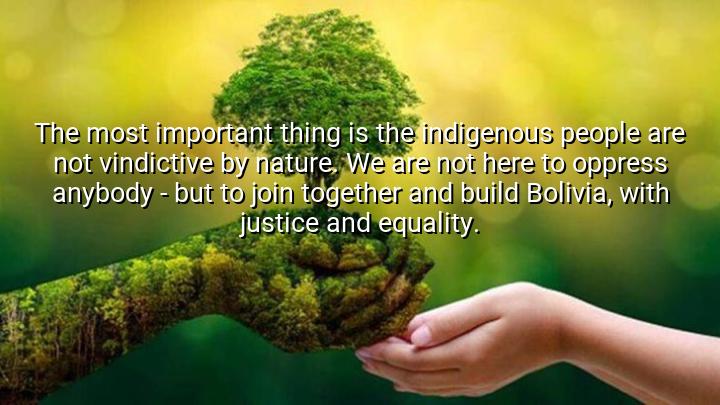




Evo Morales’ quote highlights his vision for unity and equality in Bolivia, focusing on the importance of solidarity among the indigenous people and their willingness to contribute positively to the nation. By stating that indigenous people are "not vindictive by nature," Morales emphasizes the peaceful and non-confrontational approach of indigenous communities, suggesting that they are not motivated by revenge or hostility, but rather by the desire to coexist and work together for a better future. This is a reminder that the aim of indigenous movements is not to oppress others, but to find justice and fairness for all groups in society.
The phrase "we are not here to oppress anybody" reflects Morales’ rejection of exclusionary or divisive ideologies, positioning the indigenous population as allies in building a more inclusive Bolivia. Morales' focus on justice and equality indicates his political platform, which centers on addressing the historical marginalization of indigenous communities, ensuring that they have an equal stake in the country's progress. The quote illustrates his belief that Bolivia’s growth should be driven by cooperation rather than conflict, with everyone working toward a common goal.
The origin of this quote is tied to Morales' leadership as Bolivia's first indigenous president and his efforts to bring about social change and political reform in a country that had long struggled with inequality. His presidency marked a significant shift in Bolivian politics, as he championed policies aimed at giving indigenous people more representation, rights, and opportunities in governance. This quote reflects his broader vision of a Bolivia where all citizens, regardless of their background, are treated with respect and dignity.
Ultimately, Morales’ statement emphasizes his commitment to justice, equality, and reconciliation in Bolivia. He frames the indigenous people not as adversaries but as active participants in the creation of a fairer and more just society, illustrating his belief in building a future where all groups can contribute to the nation’s prosperity without fear of oppression or marginalization.

AAdministratorAdministrator
Welcome, honored guests. Please leave a comment, we will respond soon