

The most important kind of freedom is to be what you really are. You trade in your reality for a role. You give up your ability to feel, and in exchange, put on a mask.
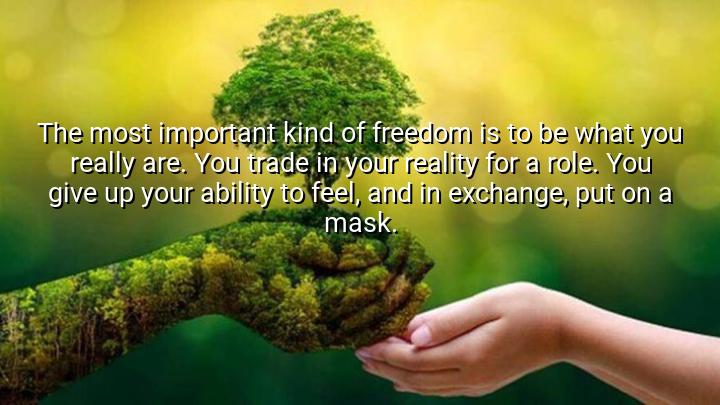




The quote "The most important kind of freedom is to be what you really are. You trade in your reality for a role. You give up your ability to feel, and in exchange, put on a mask" by Jim Morrison emphasizes the importance of embracing one’s true self rather than conforming to societal expectations or adopting a false persona. Morrison argues that true freedom comes from being authentic and genuine, rather than suppressing your true identity to fit into prescribed roles. When people "trade in their reality for a role," they lose the freedom to express their authentic emotions and thoughts, instead choosing to present a mask to the world.
The mask in this quote symbolizes the façades people put on to meet social norms, expectations, or to gain approval. By doing so, individuals may feel disconnected from their true selves and lose the ability to feel deeply, as they suppress their real emotions and desires. Morrison suggests that this act of masking is a form of self-deception that limits personal freedom and emotional depth, which are essential for living an honest and fulfilling life.
Morrison’s philosophy, rooted in existentialism and individualism, is often reflected in his music with The Doors, where he explored themes of personal freedom, rebellion, and the quest for authenticity. In this quote, he calls for a return to authenticity and encourages people to reject societal pressures that lead them to hide their true identity behind a metaphorical mask. True freedom, according to Morrison, is not found in conformity but in embracing one’s individuality without fear of judgment.
As the lead singer and lyricist of The Doors, Jim Morrison often confronted themes of self-expression and the struggle for personal freedom. His quote reflects his belief in the importance of individuality and the risks of losing one’s sense of self in the pursuit of social acceptance. For Morrison, freedom was deeply tied to being able to live and act in accordance with one’s true nature, free from the constraints of external expectations.

AAdministratorAdministrator
Welcome, honored guests. Please leave a comment, we will respond soon