

The most formative time of our lives are the years between birth and age 21, when we explore who we are and learn from those who surround us.
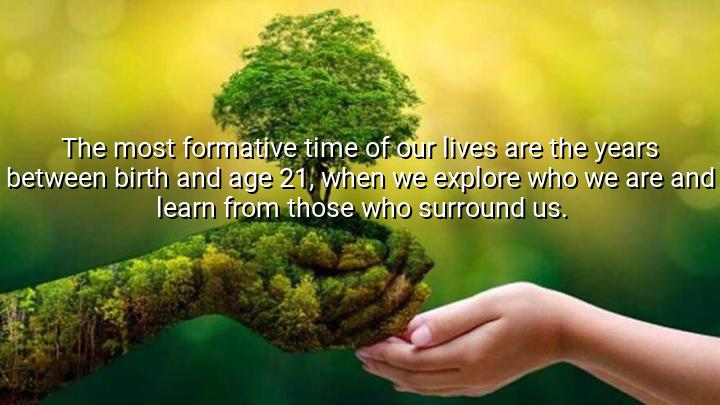




Ben Shapiro’s quote, "The most formative time of our lives are the years between birth and age 21, when we explore who we are and learn from those who surround us," emphasizes the crucial developmental period in a person’s life when their identity is shaped. Shapiro points out that from birth to the age of 21, individuals undergo significant emotional, intellectual, and social growth. These years are marked by self-discovery, as we explore our values, beliefs, and place in the world, with influences from our families, communities, and experiences playing a pivotal role.
The quote highlights that identity formation is most strongly influenced during this period, as it is the time when individuals are most impressionable. During these years, people absorb lessons from their surroundings, whether through family, education, or social environments. The experiences and relationships we form during this time shape the decisions, attitudes, and beliefs that guide us into adulthood.
Ben Shapiro, a political commentator and author, is known for his views on society, culture, and politics. His perspective on the formative years underscores his belief in the importance of early education and family influence in shaping the beliefs and worldview of individuals. Shapiro often discusses the influence of culture on personal development, and this quote reflects his view on the foundational role of the teenage and young adult years in creating well-rounded individuals.
In essence, Shapiro’s quote serves as a reminder of how critical the years between birth and 21 are in determining the trajectory of our lives. During this time, we not only learn from external influences but also begin to define our personal identities. The foundation laid in these years has a lasting impact on how we perceive ourselves and interact with the world around us.

LNLinh Nguyen
This quote is a good reminder of how much the people around us affect our growth. It made me think about mentors, teachers, and even peers who influenced me without me realizing it at the time. But I also feel a bit uneasy about putting such a hard boundary at age 21. What about people who bloom late or find their path in their 30s or 40s? Are they exceptions or part of a larger pattern?
QTNguyen Quang Tung
While I think Shapiro captures the importance of youth development, I’m left questioning how much agency we have in those years. As kids and teens, we don’t always get to choose our influences. That means the 'formative years' can also be years of inherited trauma or bias. Maybe we need to better define what it means to 'explore who we are' when so much depends on our circumstances.
GQgiang quynh
I agree that birth to 21 is a critical phase, but it makes me wonder how much of 'who we are' is truly chosen versus modeled. If we’re shaped by those around us, what happens when we grow up in a damaging or restrictive environment? Do we have enough mechanisms as adults to revise or unlearn what we absorbed early on? It’s a profound thought that deserves more discussion.
TLPHAM THI LIEN
This quote makes a good point, but I think it underestimates lifelong growth. Yes, we learn a lot about identity and values before 21, but what about reinvention? People often shift their beliefs, careers, or personalities after major life events well into adulthood. I’d love to ask Ben Shapiro whether he believes personal growth stagnates after 21, or if he simply meant the early years set the initial tone.
PDNguyen Phuoc Danh
I find this statement insightful. It acknowledges how deeply we’re influenced by our environment during our early years. It makes me reflect on the importance of family, community, and education. But it also makes me concerned for children who grow up in toxic or unstable environments—how much harder it must be to overcome those early imprints. Should we be doing more to support young people during this foundational period?