

The more help a person has in his garden, the less it belongs to him.
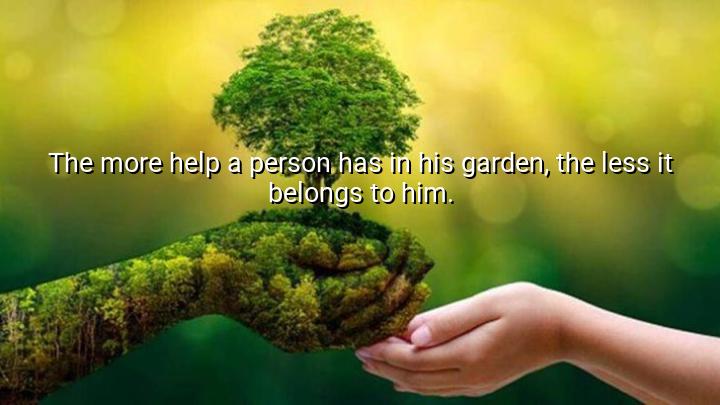




The quote "The more help a person has in his garden, the less it belongs to him" by W. H. Davies reflects the idea that ownership and personal connection to something are diminished when others are involved in its creation or upkeep. Davies suggests that when a person relies on external help to tend to their garden, it becomes less of a personal achievement and more of a collective effort. The garden, in this sense, no longer fully represents the individual's care, effort, and time, but rather the work of others who have contributed to its growth.
This quote can also be interpreted as a commentary on independence and self-reliance. The act of cultivating a garden is often seen as a deeply personal endeavor, where the gardener's efforts are directly linked to the success of the plants. When others step in to help, the individual may lose some sense of accomplishment or ownership. The garden, once a product of the gardener's own labor, becomes less an expression of their personal commitment and more a shared project.
Davies's statement touches on a deeper idea about the value of personal effort and ownership in achieving something meaningful. It suggests that true fulfillment often comes from direct involvement and that the more a person is removed from the process, the less they can truly claim something as their own. This is not just limited to gardening but can apply to any area of life where personal investment and work are key to the result.
W. H. Davies was a Welsh poet and author, known for his reflections on nature, simplicity, and self-reliance. This quote reflects his appreciation for the rewards of personal labor and the idea that true ownership comes from the effort one puts into something. It encourages a deeper connection to the things we create, emphasizing the importance of personal investment and involvement in the things we value.

AAdministratorAdministrator
Welcome, honored guests. Please leave a comment, we will respond soon