

The main topic I'm always talking about is equality, and I get that it's politics, but it shouldn't be. It should be the most normal thing ever. There's bullying and discrimination about the colour of your skin, your religion. And it must end.
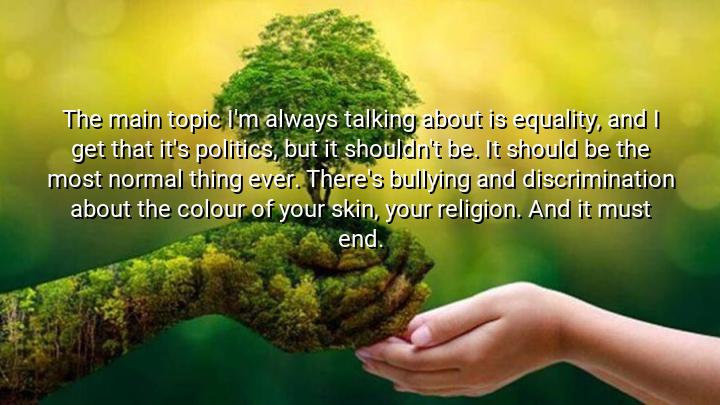




When Conchita Wurst declares, “The main topic I'm always talking about is equality, and I get that it's politics, but it shouldn't be,” the emphasis is on how equality is too often treated as a political battleground rather than a basic human standard. By calling it something that “should be the most normal thing ever,” Wurst points to the gap between the ideal of fairness and the reality of daily life, where acceptance still has to be argued for.
The mention of bullying and discrimination brings the issue down from lofty principles to lived experience. Prejudice based on skin colour or religion is presented not as abstract injustice but as tangible harm that people endure. By naming these forms of marginalization, Wurst highlights the persistence of divisions that ought to have no place in modern society. The simplicity of the statement—“And it must end”—gives it both moral clarity and urgency.
The origin of this quote is tied to Conchita Wurst’s public role as a performer and LGBTQ+ icon, particularly after winning the Eurovision Song Contest in 2014. Wurst’s visibility challenged norms of gender expression and sparked both celebration and backlash. Speaking about equality was not just a theoretical stance but a reflection of personal experience, as someone who had faced prejudice and understood the stakes of intolerance.
Ultimately, the quote captures Wurst’s vision of a society where acceptance should not be debated but assumed. By framing equality as something natural rather than political, Wurst invites us to reimagine it as an everyday truth rather than a distant aspiration. The statement is both a protest against ongoing injustice and a reminder that the most radical ideas are sometimes the simplest.
Would you like me to also show how Wurst’s phrasing echoes broader civil rights language, linking personal testimony with universal ideals?

AAdministratorAdministrator
Welcome, honored guests. Please leave a comment, we will respond soon