

The golden age is before us, not behind us.
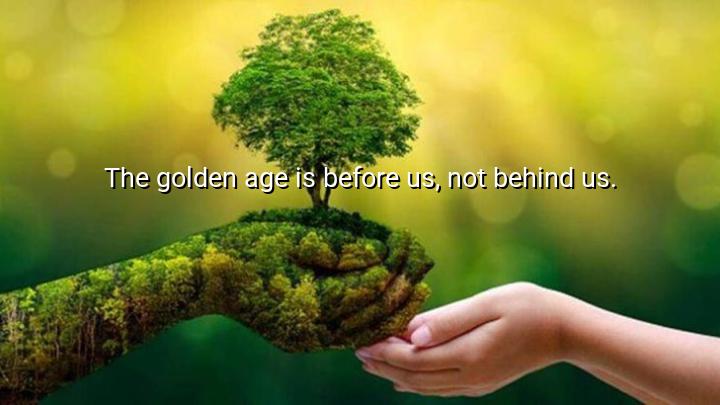




In this quote, Simon the Zealot expresses an optimistic view of the future, suggesting that the golden age—a period of great prosperity and happiness—is not something from the past but is yet to come. This contrasts with the common belief that the best times or achievements belong to previous generations. Instead, Simon sees the future as a time full of potential, where the idealized moments of human history can still be realized, challenging the notion of nostalgia for past eras.
The idea of the golden age typically refers to a period of utopian conditions, where society flourishes and peace, prosperity, and justice reign. By stating that the golden age is before us, Simon the Zealot implies that we have yet to experience such a time, and it is in our hands to create it. The quote serves as a call to look forward with hope and ambition, encouraging the belief that the future holds the promise of something even better than what has already been achieved.
Simon’s perspective also challenges the concept of historical decline, which suggests that each era is progressively worse than the last. Instead, he proposes that there is progress and improvement ahead, encouraging people to focus on the future with optimism and to take action toward shaping a better world. The golden age is not a bygone period to be mourned, but a potential reality that can be achieved through effort and vision.
Ultimately, Simon the Zealot encourages a mindset that focuses on the possibilities and opportunities of the future rather than the limitations of the past. His quote serves as a reminder that the golden age we seek is something we have the power to create, and that the best days are still ahead of us.

PMPhuong Minh
I’d love to know how this quote plays out in different contexts. For someone living in poverty or war, would this idea feel inspiring or out of touch? And in what ways do our personal experiences shape whether we see the future as golden or grim? It’s an optimistic claim, but I wonder how much privilege or belief plays into one’s ability to actually feel that truth.
Y139 - Nguyen Thi Nhu Y 12a2
Honestly, I’m torn. I want to believe this quote, but it feels hard to embrace when the world seems to be on fire—literally and figuratively. Can we still claim that the golden age lies ahead when we're facing so many global threats? Or is this exactly the kind of thinking we need to inspire change? Maybe it’s less about predicting the future and more about deciding to invest in it.
TMNguyen Thi Mai
It’s refreshing to see such a forward-looking perspective, especially when so many people seem stuck in nostalgia. But what does it mean to believe the best is yet to come? Does it depend on collective progress—technology, society, justice—or is it more personal, like emotional or spiritual growth? I wonder if this kind of mindset actually shapes how we experience life, pushing us to build the very future we hope for.
VKPham Van Khoa
This makes me wonder: is the idea of a future golden age a form of motivation, or just a way to cope with disappointment in the present? If we always believe something better is coming, do we risk ignoring the value of what we already have? Or worse, do we delay necessary change because we’re waiting for something ideal to just happen? It’s a beautiful sentiment, but it invites some hard questions.
VNvy nguyen
I find this quote really hopeful, but is it realistic? So many people seem to believe that society is in decline or that we’ve lost something essential from the past. What makes someone believe that the best is yet to come, especially in a world full of conflict, inequality, and environmental crisis? Is this faith in the future naive optimism, or a powerful act of resistance against cynicism and despair?