

The charm of history and its enigmatic lesson consist in the fact that, from age to age, nothing changes and yet everything is completely different.
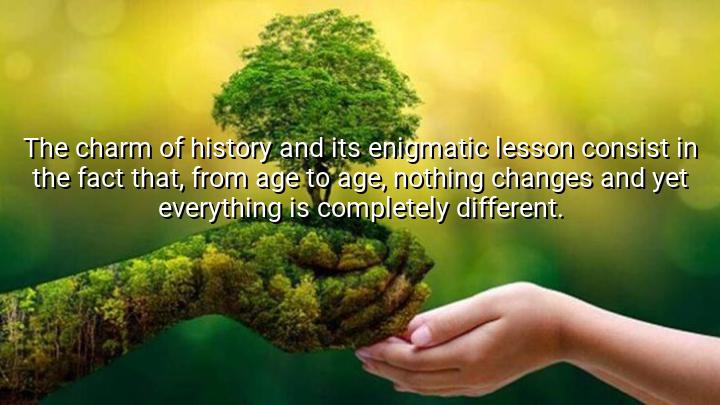




Aldous Huxley’s quote, "The charm of history and its enigmatic lesson consist in the fact that, from age to age, nothing changes and yet everything is completely different," reflects on the paradoxical nature of history. Huxley suggests that, while the broad themes of human existence—such as power, conflict, and society—remain relatively consistent over time, the specific circumstances, challenges, and outcomes of each era are always unique. This duality of continuity and change is what makes history both fascinating and complex, as we often find ourselves confronting familiar struggles, but in radically different forms.
The quote speaks to the cyclical nature of history—how the issues faced by one generation can often mirror those of previous generations, yet the context in which they unfold makes them distinct. For example, the challenges of power, governance, or social inequality have existed throughout time, but each period brings new technologies, ideas, and social dynamics that shape the way these issues manifest. Huxley is pointing out that while the fundamentals of human life may not drastically change, our understanding and approach to those fundamentals evolve in unique ways as time progresses.
Aldous Huxley, an influential English writer and philosopher, is best known for his dystopian novel Brave New World, which explores the impact of technology, science, and society on humanity. His quote encapsulates his broader philosophy, which often dealt with the tension between tradition and progress. Huxley was keenly aware of how modern society was evolving in ways that mirrored past mistakes, making his observations about history particularly poignant.
In essence, Huxley’s quote suggests that history is both cyclical and ever-evolving. While certain patterns and themes remain constant, the specific details and contexts are always shifting, leading to new understandings of old problems. This dynamic makes history both a rich source of lessons and a reminder of how change and continuity are intertwined, providing a deeper appreciation for the complexities of the human experience across ages.

HVDang Hoang Viet
This quote makes me feel a bit conflicted. On one hand, it's comforting to see familiar patterns in history—it creates a sense of continuity. On the other hand, it’s frustrating that we keep making similar mistakes. I’m curious if this reflects a flaw in collective memory or if it’s just part of the human condition. Can we ever truly break free from this cycle, or is it just how civilization functions?
NMDuong Ngoc Mai
Huxley's insight feels incredibly relevant in today’s world. We have smartphones and space travel, yet we still struggle with basic issues like inequality and tribalism. I wonder—does this quote suggest that human nature is fundamentally resistant to change? Or that external shifts can’t mask the internal constancies of who we are? It's a powerful prompt to examine whether history teaches us anything at all—or simply amuses us with its patterns.
HPDinh Van Hong Phuc
This quote reminds me of how fashion trends, political ideologies, even societal fears recycle through time. There’s something poetic about the rhythm of history—familiar yet unfamiliar. But what does it mean for progress? If everything changes but nothing truly does, are we just spinning in place? I think this perspective invites us to question what real change looks like, and whether we’re genuinely evolving or just changing the setting of the same old play.
MMinh
I love how Huxley captures the contradiction of history—it’s the same stories in different costumes. I wonder, though, is this repetition a flaw or a feature of humanity? Are we doomed to relive variations of the same struggles, or does this give us opportunities to evolve each time? His words feel like a warning and a mirror. What role do education and collective memory play in breaking—or at least reshaping—these historical loops?
TPDang Tran Phu
Huxley’s observation makes me think about the cyclical nature of human behavior. We always think we’re progressing, but then events like economic collapse or political unrest remind us of past centuries. Is it comforting or depressing to realize we’re not that different from our ancestors? Maybe it’s a call for humility—that despite our modern advancements, the core of what drives us hasn’t changed much over the ages.