

The biggest disease this day and age is that of people feeling unloved.
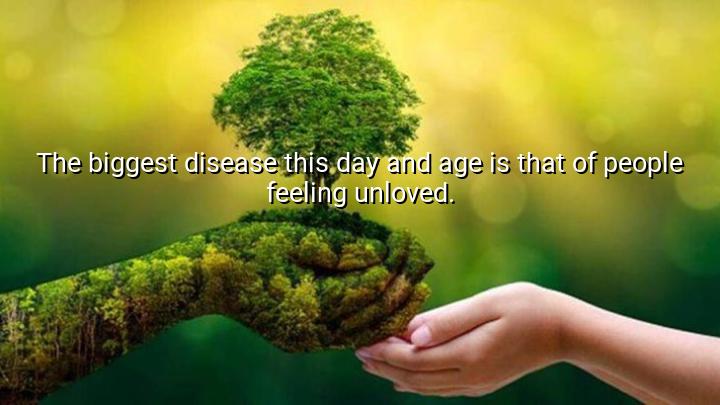




Princess Diana’s quote, "The biggest disease this day and age is that of people feeling unloved," emphasizes the profound emotional and psychological impact of feeling disconnected or unappreciated in modern society. Diana, who was deeply involved in charity work and humanitarian causes, believed that the lack of love and emotional connection in people’s lives was a major issue in contemporary times. She suggests that, in an increasingly fast-paced and impersonal world, emotional neglect or isolation is a "disease" that affects the well-being of individuals, potentially leading to feelings of despair, loneliness, and low self-worth.
The quote also reflects Diana's concern for the emotional health of individuals, particularly those who feel excluded, unloved, or neglected by society. In her view, the feeling of being unloved is more destructive than many physical ailments, as it affects a person’s mental health, self-esteem, and sense of belonging. Diana often spoke about the importance of compassion, empathy, and emotional support, particularly for vulnerable populations, and this quote embodies that philosophy, highlighting the critical role love plays in maintaining emotional balance and well-being.
Princess Diana was widely admired not only for her royal duties but also for her work with charities focused on children, the homeless, and people suffering from diseases like HIV/AIDS. Her quote speaks to her deep empathy and understanding of human nature, and her recognition of how emotional isolation and the lack of love can manifest in society, often leading to negative outcomes like mental health struggles or societal disconnection.
In essence, Diana’s quote underscores the idea that emotional health is just as important as physical health, if not more so. It emphasizes that the feeling of being unloved can have a profound and lasting impact on an individual’s life, making it a significant issue in the modern world. By calling attention to this "disease," Diana urged society to recognize the importance of fostering love, compassion, and connection among individuals to combat feelings of isolation and neglect.

PVphuong vy
I think this quote reflects Diana’s deep sensitivity to human suffering. It’s easy to dismiss emotional needs as secondary, but feeling unloved can destroy a person’s spirit. What’s tragic is that it often goes unnoticed — there’s no cast or bandage for a lonely heart. What if we approached emotional care with the same urgency as physical illness? Would our world be a kinder place?
BVBao Vi
It’s heartbreaking how relevant this still feels. So many people suffer in silence, feeling unloved even when surrounded by others. I wonder, are we failing each other emotionally? Society tends to treat loneliness like a personal issue, but maybe it’s really a collective failure in how we love, listen, and show up for one another. Could prioritizing compassion be the antidote to this emotional epidemic?
GOThay Giao Omen
This is such a simple but powerful observation. I think she was pointing to a truth that still rings true today — maybe even more so. Loneliness is everywhere, especially with social media making it seem like everyone else is constantly loved and supported. But how do we bridge the gap between superficial interaction and genuine connection? Is there a cure for emotional isolation in a hyperconnected world?
KOGiap Kim Oanh
Princess Diana’s quote feels timeless. It gets to the heart of what’s missing in modern life. We talk a lot about mental health now, but do we truly understand how much of it is rooted in feeling unloved or unseen? It’s not just about romance either — it’s about human connection. How do we create communities where people feel valued, especially when everything moves so fast?
HDLe duy hai dang
This quote hits hard — it speaks to a kind of emotional poverty that often goes unnoticed. We live in a time of constant connection through technology, yet so many people feel completely alone. Why is that? Is it that we’ve forgotten how to show real affection and empathy? Diana’s words make me wonder how we might change our culture to prioritize emotional well-being as much as physical health.