

The beauty of architecture is it involves work that stretches over a very long time but often starts in one instant, with just one emotion, a kind of instinctual response.
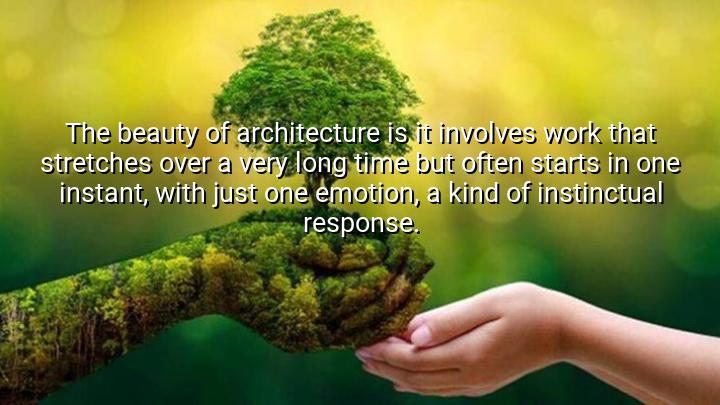




The quote by Ma Yansong — "The beauty of architecture is it involves work that stretches over a very long time but often starts in one instant, with just one emotion, a kind of instinctual response." — captures the poetic and emotional foundation of architectural creation. Ma highlights a fascinating contrast: while buildings take years to design, develop, and construct, the initial inspiration often arises in a fleeting moment of emotional clarity or creative spark. This moment may be born out of a personal experience, a visual impression, or an intuitive reaction to a place or idea.
By referring to that first emotion or instinctual response, Ma suggests that architecture is not purely a rational or technical discipline—it is also deeply artistic and emotive. Great design begins not with measurements or codes, but with a feeling, a vision, or a human impulse to shape space in a meaningful way. This initial emotional trigger then sets in motion a long and complex process of refinement, engineering, and collaboration, evolving into something tangible and lasting.
Ma Yansong’s approach reflects his broader architectural philosophy, which emphasizes sensory experience, natural forms, and emotional engagement. As the founder of MAD Architects, he has become known for designs that feel organic, dreamlike, and deeply rooted in human emotion. His quote reveals how the soul of a building can stem from a moment of inspiration, even as its realization demands discipline and time.
The origin of this quote likely comes from interviews or public lectures where Ma shares his design ideology. His belief in architecture as both a temporal journey and an emotional expression challenges the idea of design as purely utilitarian. Instead, Ma positions architecture as a bridge between intuition and permanence, where a single moment of feeling can evolve into a structure that defines a skyline or transforms a community.

AAdministratorAdministrator
Welcome, honored guests. Please leave a comment, we will respond soon