

A pool at the edge of the ocean is the simplest geometry, yet you feel connected to the sea. In a forest with the mountains in the background, you also feel the connection to nature, yet it's a very complex geometry. I think architecture is about controlling these feelings.
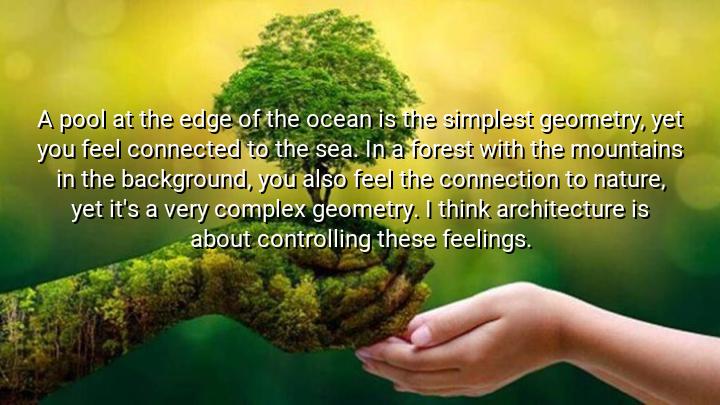




The quote by Ma Yansong — "A pool at the edge of the ocean is the simplest geometry, yet you feel connected to the sea. In a forest with the mountains in the background, you also feel the connection to nature, yet it's a very complex geometry. I think architecture is about controlling these feelings." — reflects his philosophy that architecture is not just about form or function, but about shaping emotional experiences through space. He contrasts two types of natural environments: one defined by simplicity and the other by complexity, yet both evoke a strong sense of connection to nature. For Ma, the role of architecture is to harness and orchestrate these emotional responses.
By using examples like a pool beside the ocean and a forest framed by mountains, Ma illustrates how contextual design interacts with the human psyche. A minimalist setting might trigger a feeling of peace and openness, while a more layered, intricate environment might invoke awe or wonder. His use of the term geometry refers not only to the physical shape of spaces but to how those shapes interact with the natural world and the observer’s emotional perception.
The quote’s origin lies in Ma Yansong’s broader design ideology, which blends natural landscapes, organic forms, and human-centered experiences. As the founder of MAD Architects, Ma is known for creating structures that appear to grow out of the environment — fluid, sculptural, and deeply tied to their surroundings. His projects, such as the Harbin Opera House and the Huangshan Mountain Village, demonstrate how architecture can complement nature rather than dominate it, reinforcing his belief in emotional spatial design.
Ultimately, Ma’s statement challenges traditional architectural thinking that prioritizes logic and structure. He invites architects to think beyond technical constraints and to design with emotion, sensation, and human-nature connection in mind. Whether in simple or complex settings, architecture becomes a tool to amplify the feelings that emerge when humans encounter their environment — turning built forms into experiences that resonate with the soul.

AAdministratorAdministrator
Welcome, honored guests. Please leave a comment, we will respond soon