

The Atomic Age is here to stay - but are we?
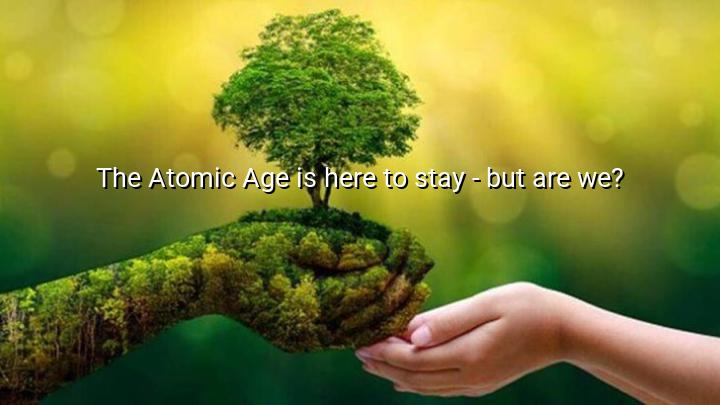




The quote, "The Atomic Age is here to stay - but are we?", comes from Bennett Cerf, an American publisher and co-founder of Random House. This statement reflects the sense of both optimism and unease that accompanied the dawning of the Atomic Age in the mid-20th century, following the development and use of nuclear weapons during World War II. Cerf acknowledges that the Atomic Age, marked by the increasing reliance on nuclear technology, has become an undeniable part of the modern world, but he questions whether humanity can endure in this new era.
Cerf’s use of "here to stay" suggests that the advent of nuclear technology is a permanent shift in human civilization. The Atomic Age represents a time when the potential for destruction through nuclear weapons became a constant reality, impacting global politics, military strategies, and international relations. By declaring it “here to stay,” Cerf emphasizes that there is no turning back from this technological revolution.
However, the second part of the quote, "but are we?", introduces a note of doubt and concern about humanity's future. While the Atomic Age may be a lasting feature of modern life, Cerf poses the existential question of whether humanity itself can survive in this new environment. The phrase reflects the fear that nuclear technology, if misused, could lead to self-destruction and that the future of civilization might be at risk due to the very technology that promises progress.
Ultimately, Cerf’s quote encapsulates the uncertainty and danger of the Atomic Age. It reminds us that while technological advancements like nuclear power can shape and transform the world, they also come with great responsibility. The quote serves as both an acknowledgment of human achievement and a warning about the potential consequences of unchecked technological power.

VDTu Vuong Duy
I appreciate the dark humor in this quote. It’s witty, but behind that wit is a serious existential concern. The idea that human ingenuity might outpace human wisdom isn’t new, but it’s rarely stated this concisely. Do we ever stop to ask if we deserve the power we’ve harnessed? Or whether we’re psychologically and morally equipped to handle it long-term?
TMPhung Ngoc Tra My
The quote is unsettling, and that’s what makes it effective. The Atomic Age brought both promise and peril, yet Cerf’s question suggests that our own survival is still uncertain. What conditions would make us worthy of outlasting our inventions? Is it humility, cooperation, foresight? And are we, as a global society, cultivating those traits—or neglecting them?
NTDung 12_9 Nguyen Tien
There's something hauntingly prophetic about this. It’s like Cerf is throwing down a gauntlet to future generations: will we use this immense power for good, or will we be undone by it? It also makes me think about other global challenges—climate change, AI, bioengineering. Are we really prepared to handle the tools we’ve created, or are we just gambling with our future?
ATngo thi anh thu
What a provocative question. It reflects the paradox of human achievement—we’ve unlocked atomic energy, but now we’re tasked with surviving our own creations. It’s easy to celebrate innovation, but Cerf reminds us to question whether our survival instincts and global cooperation can keep up. Can we truly manage what we’ve unleashed, or are we sleepwalking toward disaster?
NSnguyen sam
This feels like a chilling yet clever observation. The ‘Atomic Age’ symbolizes progress, but also immense destruction. It makes me wonder: have we become too comfortable with the threat of nuclear weapons and power? We live in a world shaped by science, but do we reflect enough on its consequences? Cerf’s quote invites that deeper, uncomfortable introspection we often avoid.