

That's part of American greatness, is discrimination. Yes, sir. Inequality, I think, breeds freedom and gives a man opportunity.
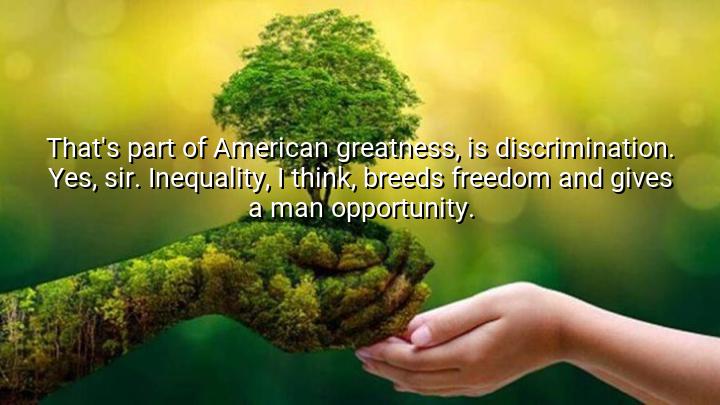




The quote "That's part of American greatness, is discrimination. Yes, sir. Inequality, I think, breeds freedom and gives a man opportunity" by Lester Maddox is a controversial statement that reflects the racially charged views held by Maddox, a former governor of Georgia. In this quote, Maddox appears to suggest that discrimination and inequality are inherent to the success and opportunity found in America. He seems to imply that these societal ills somehow create freedom and provide opportunity for individuals, which is a highly problematic view that ignores the harm caused by discrimination.
The origin of this quote comes from Maddox's public stance on segregation and his involvement in upholding discriminatory practices in the American South during the civil rights movement. As a politician, Maddox was known for his staunch opposition to racial integration, famously refusing to serve African Americans in his restaurant and advocating for segregationist policies. His view, as expressed in this quote, reflects a distorted interpretation of American greatness by associating inequality with progress and freedom, a belief that was widely challenged and rejected during the civil rights era.
The statement is deeply controversial because it suggests that inequality and discrimination are somehow beneficial to society by creating opportunities for some individuals. This view stands in stark contrast to the ideals of equality, justice, and civil rights, which argue that true freedom and opportunity come from eliminating discrimination and ensuring equal treatment for all. Maddox’s quote embodies a perspective that was used to justify the oppression and marginalization of African Americans during a time when the civil rights movement was fighting for racial equality.
Ultimately, Lester Maddox's quote serves as a reminder of the deeply entrenched racial prejudices and discriminatory attitudes that existed in certain parts of America during the 20th century. His statement was a reflection of the way some individuals viewed inequality and discrimination as necessary for maintaining social order, a view that was widely contested and criticized by those advocating for freedom and equality. This quote stands as a historical example of the ideological struggle for civil rights and social justice in the United States.

AAdministratorAdministrator
Welcome, honored guests. Please leave a comment, we will respond soon