

Testimony should be a philosophical problem and not limited to legal or historical contexts where it refers to the account of a witness who reports what he has seen.
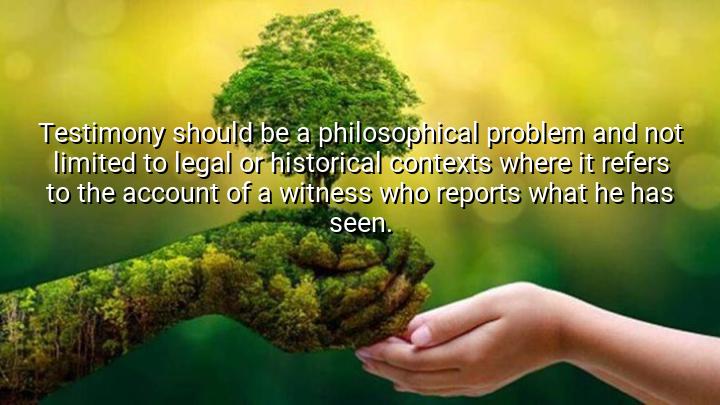




The quote by Paul Ricoeur emphasizes that testimony extends beyond its conventional role in legal or historical contexts. While testimony is often understood as the account of a witness reporting what they have seen, Ricoeur argues that it should also be considered a philosophical problem. This perspective encourages deeper reflection on the nature of truth, memory, and human experience, rather than limiting testimony to procedural or evidentiary purposes.
By framing testimony as a philosophical issue, Ricoeur highlights questions about the reliability, interpretation, and meaning of human accounts. Testimony is not just a factual recounting; it involves subjective perception, ethical responsibility, and the transmission of experience. This approach invites consideration of how testimony shapes understanding, memory, and collective knowledge, especially in morally and historically significant contexts.
The origin of this perspective comes from Ricoeur’s work as a French philosopher known for his contributions to hermeneutics, phenomenology, and ethics. Throughout his career, he explored how language, narrative, and testimony mediate human understanding and moral responsibility, arguing for a broader conception of testimony that transcends narrow disciplinary boundaries.
Ultimately, the quote underscores the importance of treating testimony as both an epistemological and ethical concept. Ricoeur calls for a view in which witnessing and recounting events involves not only factual accuracy but also philosophical reflection on truth, responsibility, and the human experience, enriching our understanding of history, justice, and morality.

AAdministratorAdministrator
Welcome, honored guests. Please leave a comment, we will respond soon