

Strictly speaking, my interest is not in legal rights for animals but in a change of heart towards animals.
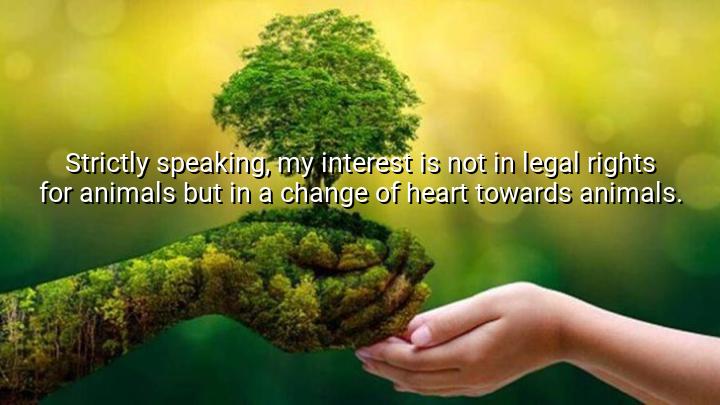




J. M. Coetzee’s quote emphasizes that his primary concern is not the pursuit of legal rights for animals, but rather a shift in attitudes or a change of heart toward them. Coetzee suggests that legal rights alone may not be sufficient to improve the treatment of animals; instead, there needs to be a deeper, more fundamental change in how humans view and interact with animals. The focus is on encouraging compassion and empathy rather than simply enacting laws to protect them.
The quote points to the importance of a moral and ethical transformation in society. Coetzee implies that true progress in the treatment of animals comes from altering people's perspectives about animals’ intrinsic worth, rather than relying solely on legislation. A change in heart would foster a more genuine, widespread respect for animals, leading to better behavioral change and improved treatment on a societal level.
In contrast to legal arguments, which can often be rooted in political or pragmatic concerns, Coetzee is advocating for a more holistic approach to animal welfare. His perspective suggests that moral evolution is needed for real, lasting change. Legal rights can be part of the solution, but only when supported by a fundamental shift in how humans perceive their moral responsibilities toward the animal kingdom.
The origin of this quote comes from J. M. Coetzee, a South African novelist and essayist whose works frequently address themes of ethics, social justice, and human rights. Coetzee has been an outspoken advocate for animal rights, and his writings, such as The Lives of Animals, often challenge readers to reconsider the relationship between humans and animals. His focus on empathy and moral responsibility reflects his broader concerns with humanity's treatment of the vulnerable.

AAdministratorAdministrator
Welcome, honored guests. Please leave a comment, we will respond soon