

Stone Age. Bronze Age. Iron Age. We define entire epics of humanity by the technology they use.
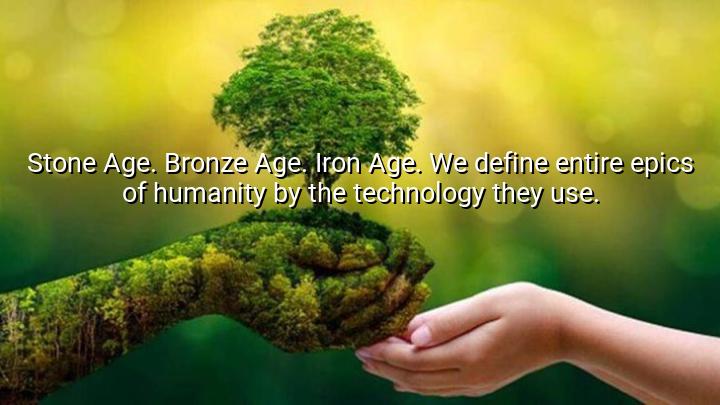




In this quote, Reed Hastings comments on how human history has traditionally been defined by the dominant technology of each era. He mentions the Stone Age, Bronze Age, and Iron Age, noting that these periods in history are marked by the materials and technological advancements that shaped society at the time. By doing so, Hastings suggests that technology has been a key factor in shaping the progression of human civilization and the way we categorize historical periods.
Hastings’ statement underscores the powerful influence that technological advancements have had on human development. Each new era is characterized by the tools and innovations that emerged, dramatically altering the way people lived, worked, and interacted with the world. The introduction of materials like stone, bronze, and iron not only transformed everyday life but also had significant impacts on society, culture, and economy.
The quote also draws attention to the way humans tend to define themselves through innovation and progress, often seeing each technological leap as a marker of civilization’s advancement. This framing suggests that technology is more than just a tool—it is an essential element in the shaping of human history and identity. Hastings implies that, much like past eras, the current age might one day be defined by the technologies of today.
Ultimately, Reed Hastings highlights the enduring role of technology in defining human history. As we move forward, the technologies of our time—whether in communication, transportation, or digital media—will shape how future generations perceive the world we live in, just as the Stone, Bronze, and Iron Ages have defined past epochs. The quote invites reflection on how the current technological landscape will be remembered and how it will influence the future.

TNTran Thuy Nhi
This quote feels deceptively simple but actually raises big questions about how we measure progress. If we’ve always defined ourselves by tools—stone, bronze, iron—what happens when the most powerful tools are invisible, like data and algorithms? Do we risk losing sight of the human story behind the tech? Maybe we need a new framework for thinking about our time—one that balances innovation with humanity, instead of just celebrating what we invent.
TLNguyen Thi Thuy Linh
I’ve never thought about history this way before, but it’s oddly true. We remember epochs by their tools, not their people. Why is that? Maybe because technology is tangible and leaves a more obvious trace than culture or emotion? But what does that say about our values as a species? Are we doomed to be remembered more for what we built than who we were or how we treated each other?
BBach
This statement hits hard, especially in today’s tech-obsessed world. It makes me wonder—will we ever reach an era where our tools stop defining us? Or is that just human nature, to tie identity to invention? I also wonder what kind of age we're in now. The Information Age? The Surveillance Age? The Climate Age? Depending on your perspective, the current 'epic' could look very different. That’s a bit unsettling, honestly.
NPNg Phuong
It’s interesting to think about how we define civilizations by their tools, but not necessarily by their ideas or relationships. Shouldn’t there be an 'Empathy Age' or a 'Justice Age'? I wonder if future historians will look at our time and define us by smartphones and AI rather than social upheavals or climate change. Do we give too much credit to technology and not enough to human development in other areas?
PHGiang Nguyen Phu Hoang
This quote really makes me question how much of our identity as a species is tied to our tools rather than our values or beliefs. If technology defines our eras, what does that say about what we prioritize? Are we living in the Digital Age, the Algorithm Age, or something else entirely? And is it healthy to judge human progress primarily through the lens of technological advancement rather than ethics or culture?