

Sadly, it's much easier to create a desert than a forest.
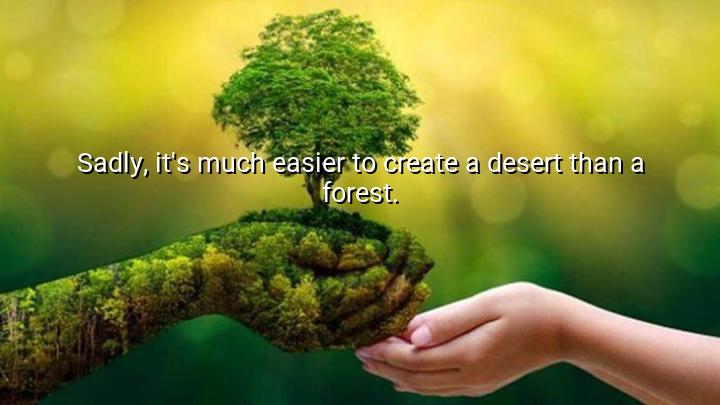




In this quote, James Lovelock highlights the stark contrast between destruction and creation in the context of environmental sustainability. Lovelock, a renowned scientist and environmentalist, is known for developing the Gaia theory, which posits that the Earth and its ecosystems function as a self-regulating system. The quote emphasizes that damage to the environment, such as creating a desert, can happen quickly and easily, while the process of nurturing and cultivating something as complex and beneficial as a forest requires patience, effort, and care.
The idea that “it's much easier to create a desert” speaks to the fragility of ecosystems and the rapid pace at which humans can harm the environment. Deserts symbolize barren, lifeless landscapes, often resulting from overuse, deforestation, and pollution. The quote suggests that human actions, driven by greed, negligence, or ignorance, can quickly lead to the degradation of natural habitats, making the Earth less hospitable for many forms of life.
On the other hand, creating a forest represents the intricate and long-term process of restoration, requiring careful planning, time, and resources to heal damaged ecosystems. A forest, with its biodiversity and interdependent systems, is a symbol of life, regeneration, and resilience. Building or restoring such an environment takes commitment, in contrast to the destructive forces that can cause devastation in a short period.
Ultimately, Lovelock’s quote serves as a warning and a call to action. It points out the ease with which humanity can harm the planet, while also emphasizing the difficulty of recovery and regeneration. The quote encourages a shift toward more sustainable and thoughtful approaches to environmental stewardship, recognizing that preserving and restoring nature is far more challenging than its destruction.

AAdministratorAdministrator
Welcome, honored guests. Please leave a comment, we will respond soon