

We'd never have got a chance to go outside and look at the earth if it hadn't been for space exploration and NASA.
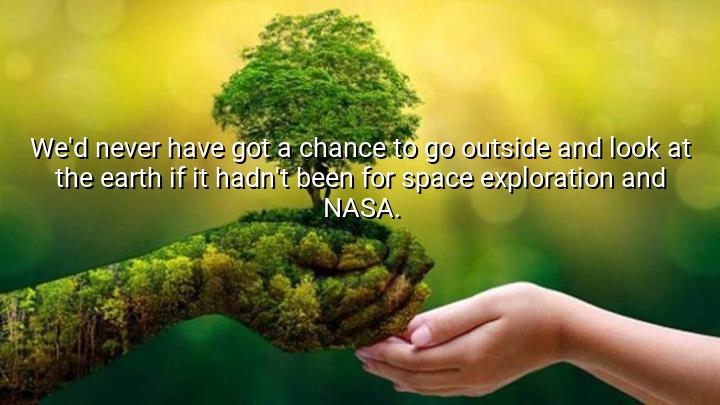




The quote "We'd never have got a chance to go outside and look at the earth if it hadn't been for space exploration and NASA" by James Lovelock reflects the profound impact that space exploration has had on our understanding of the planet. Lovelock, a renowned scientist and environmentalist, emphasizes how advancements in space exploration, particularly through the work of NASA, have allowed humans to see Earth from a new perspective. This view of the planet from space has been a powerful tool for raising awareness about environmental issues and our place in the cosmos.
Lovelock’s statement highlights the significance of space exploration beyond just scientific discovery. It underscores how the ability to observe Earth from space has helped humanity develop a greater sense of global interconnectedness and environmental responsibility. The famous images of Earth, such as the Apollo missions' photos, have made it clear that the planet is fragile, unique, and deserving of protection. Space exploration, in this sense, has not only expanded our knowledge of the universe but also deepened our understanding of the environment and the need for sustainability.
The origin of this quote stems from Lovelock’s work in the scientific community, particularly his development of the Gaia hypothesis, which posits that Earth and its biosphere function as a self-regulating system. Lovelock has long argued that human interaction with the environment should be understood as part of a larger, interconnected system. His admiration for NASA and space exploration is rooted in the idea that these achievements have helped underscore the importance of environmental stewardship.
Ultimately, Lovelock’s quote emphasizes the critical role that space exploration has played in shaping our view of Earth. By showing us our planet from an entirely new perspective, it has inspired a sense of collective responsibility toward preserving our environment. The advancements made by NASA and the space program have allowed us to see the world not just as a series of landmasses and oceans, but as a fragile, interconnected system that requires care and attention.

AAdministratorAdministrator
Welcome, honored guests. Please leave a comment, we will respond soon