

Relying on the face might be human nature - even babies prefer to look at attractive people. But, of course, judging someone based on the geometry of his features is, from a moral and legal standpoint, no better than judging him based on the color of his skin.
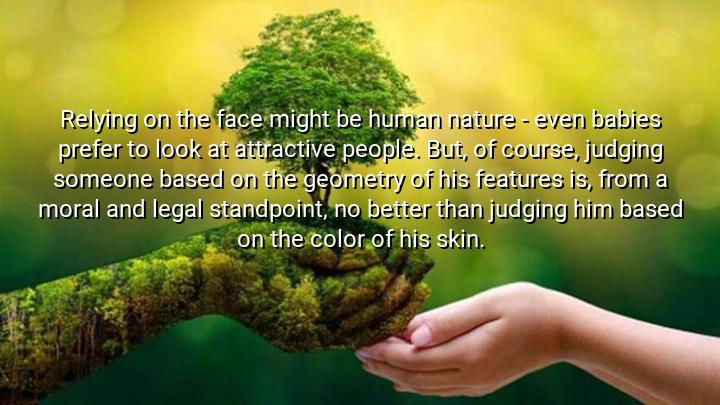




The quote by Paul Bloom explores the tension between human nature and moral reasoning. He begins by acknowledging that humans have a natural tendency to respond to faces, noting that even babies show a preference for looking at attractive people. This observation highlights the innate biological and psychological mechanisms that shape our perceptions and social preferences, suggesting that our initial impressions are often guided by appearance rather than character or behavior.
However, Bloom quickly shifts to a moral and legal perspective, cautioning that evaluating someone solely on the geometry of their features is fundamentally unfair. He equates it to judging someone based on the color of their skin, emphasizing that superficial traits should not dictate how we treat others. This comparison underscores a core principle of ethical judgment and justice: appearances, whether in attractiveness or race, are irrelevant to a person’s value, rights, or abilities.
The origin of this idea draws on psychological research into bias, attraction, and perception, as well as broader discussions in ethics and law about discrimination. Studies have consistently shown that people are influenced by physical appearance in decisions ranging from hiring to social interaction, yet Bloom reminds us that such biases are socially and morally unacceptable. His work bridges psychology with philosophy, illustrating how natural instincts can conflict with principles of fairness and equality.
Ultimately, the quote encourages self-awareness and moral reflection. While humans may instinctively favor certain appearances, Bloom challenges us to recognize these biases and ensure that our judgments are grounded in ethical standards rather than superficial traits. It is a call to align human behavior with justice, rather than letting innate preferences dictate our treatment of others.

AAdministratorAdministrator
Welcome, honored guests. Please leave a comment, we will respond soon