

Religion creates community, community creates altruism and altruism turns us away from self and towards the common good... There is something about the tenor of relationships within a religious community that makes it the best tutorial in citizenship and good neighborliness.
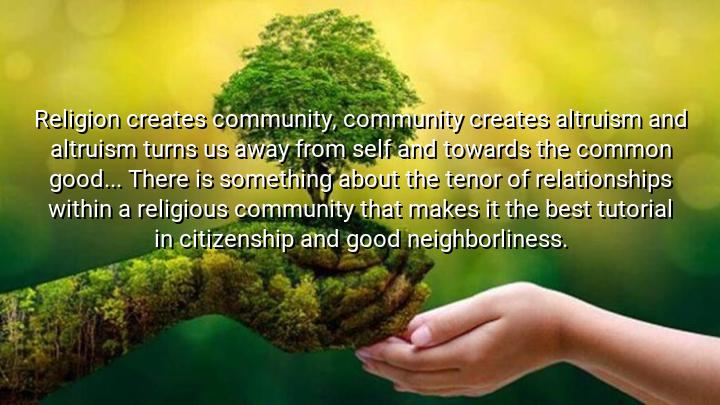




Jonathan Sacks' quote emphasizes the interconnectedness between religion, community, and altruism. He suggests that religion serves as a foundation for creating a strong sense of community, which in turn fosters a spirit of altruism — the selfless concern for the well-being of others. According to Sacks, this transformation of self-centeredness into a focus on the common good is one of the key benefits of religious communities. By encouraging individuals to prioritize the welfare of others, religion becomes a powerful force for shaping morally responsible and compassionate citizens.
Sacks further argues that the relationships within a religious community are unique in their ability to teach good neighborliness and citizenship. These relationships are built on shared values, mutual support, and collective responsibility, making religious groups a fertile ground for learning how to live harmoniously with others. The tutorial of religion, as he puts it, is not just about doctrinal knowledge, but about how to practice caring for others, which Sacks believes is central to being a responsible and empathetic member of society.
The origin of the quote is rooted in Sacks' deep understanding of Judaism and his work as a prominent rabbi and philosopher. Throughout his career, he emphasized the role of religion in fostering moral development and social responsibility. His belief that religion nurtures community and leads to better social cohesion reflects his broader views on the importance of spiritual traditions in building compassionate societies.
This quote also highlights a central theme in Sacks’ writings: the idea that religion, far from being divisive, can serve as a powerful tool for social unity and civic engagement. In a world increasingly divided along ideological lines, his perspective serves as a reminder that religious communities, grounded in shared ethical principles, can be a model for promoting the common good and fostering positive social change.

AAdministratorAdministrator
Welcome, honored guests. Please leave a comment, we will respond soon