

Dreams are where we visit the many lands and landscapes of human possibility and discover the one where we feel at home. The great religious leaders were all dreamers.
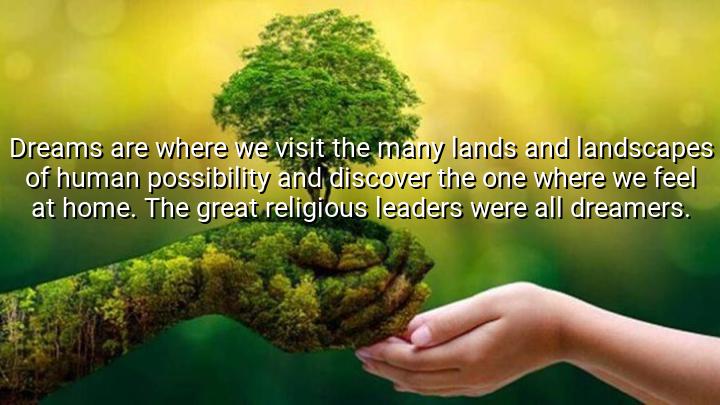




In this quote, Jonathan Sacks explores the idea that dreams are a space where individuals can explore different possibilities and potential futures. He describes dreams as a journey to various lands and landscapes of human possibility, where people can imagine different versions of themselves or their lives. The quote suggests that dreams are not just fleeting visions, but opportunities to connect with a deeper sense of purpose and identity, helping us discover the place or state where we truly feel at home.
Sacks also links dreamers to great religious leaders, implying that visionary figures in history were able to bring profound change and insight because they had the ability to dream beyond the ordinary. The idea is that religious leaders, like many others who shaped history, often connected with an idealistic or spiritual vision—one that allowed them to push boundaries and challenge conventional thinking. By referring to them as "dreamers," Sacks highlights how these leaders were able to transcend current realities and envision a better, more meaningful world.
The origin of the quote reflects Sacks' background as a religious thinker and philosopher, whose work often focused on the intersection of faith, humanity, and society. His perspective on dreams aligns with his broader understanding of spirituality and human potential. The idea that dreams are a pathway to discovering one's true calling or place in the world is central to many religious and philosophical teachings, making this statement a reflection of that belief.
Ultimately, Sacks' quote suggests that dreams are a vital part of understanding who we are and where we belong, and that those who have the vision to see beyond the present moment—like the great religious leaders—can offer insight into the deeper possibilities of human existence. Dreams, in this context, are not just about the unconscious mind, but a metaphor for vision, purpose, and spiritual growth.

AAdministratorAdministrator
Welcome, honored guests. Please leave a comment, we will respond soon