

Prejudices, it is well known, are most difficult to eradicate from the heart whose soil has never been loosened or fertilized by education; they grow firm there, firm as weeds among stones.
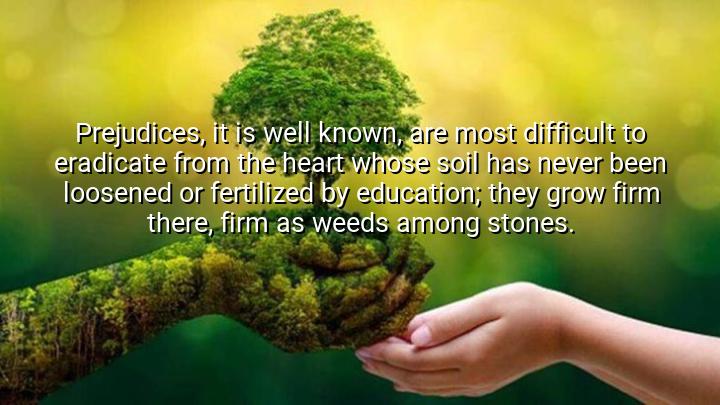




The quote “Prejudices, it is well known, are most difficult to eradicate from the heart whose soil has never been loosened or fertilized by education; they grow firm there, firm as weeds among stones.” by Charlotte Brontë emphasizes the transformative power of education in shaping attitudes and character. Brontë, an English novelist and social critic, suggests that without the nourishment of learning and critical thinking, prejudices take root easily and become deeply entrenched, much like weeds growing in barren soil.
By comparing uneducated hearts to soil unloosened and unfertilized, Brontë highlights that education is essential for cultivating open-mindedness and empathy. Just as fertile soil supports healthy growth, an educated mind is more receptive to new ideas, diversity, and understanding, making it less susceptible to bias and narrow-mindedness.
The origin of this quote comes from Brontë’s writings in the 19th century, a period when she often explored themes of social inequality, morality, and human development. Her commentary reflects a deep awareness of how ignorance and lack of intellectual cultivation can reinforce rigid social attitudes and perpetuate prejudice and discrimination.
Ultimately, this quote serves as a reminder that education is not merely about acquiring knowledge; it is also about liberating the mind from entrenched biases. Brontë encourages readers to value learning as a way to foster intellectual flexibility, moral insight, and a more just society, demonstrating that true education nurtures both the mind and the heart.

AAdministratorAdministrator
Welcome, honored guests. Please leave a comment, we will respond soon