

People are pretty much alike. It's only that our differences are more susceptible to definition than our similarities.
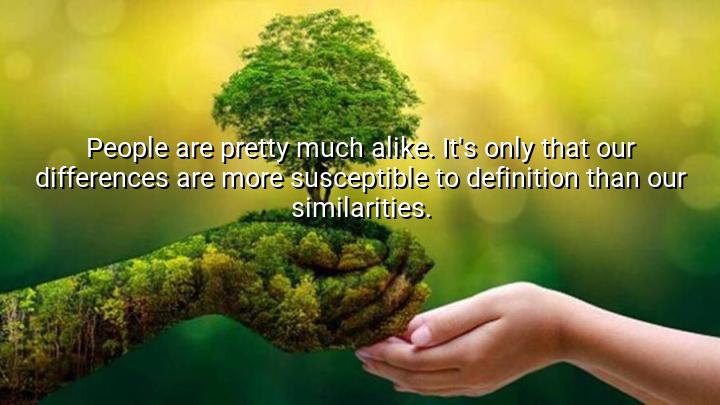




In this quote, Linda Ellerbee reflects on the commonalities and differences that exist among people. She argues that, at a fundamental level, people are largely the same, with similar needs, desires, and emotions. However, she points out that differences—such as those based on culture, race, or beliefs—are often more easily defined and emphasized, while our similarities tend to be more abstract or harder to articulate. Ellerbee suggests that society tends to focus more on what separates us rather than on what unites us.
Ellerbee’s statement speaks to the idea of social constructs and how human beings often create categories based on observable differences. These distinctions, whether related to appearance, nationality, or social status, are frequently highlighted in culture and media, leading to a stronger emphasis on division than on the inherent unity of human beings. In contrast, our shared experiences and universal human traits, like the desire for love, understanding, and connection, are often overlooked or underappreciated.
The quote challenges us to rethink how we view human diversity. While acknowledging that differences do exist, Ellerbee points out that they should not overshadow the larger, shared aspects of the human experience. The recognition of these commonalities can foster a sense of solidarity and compassion, helping to bridge divides created by societal labels and categories.
Ultimately, Ellerbee's words suggest that the way we define ourselves and others is heavily influenced by external factors and prejudices. By focusing more on the similarities between people, we may be able to create a more unified and empathetic society, where our common humanity is celebrated rather than divided by the things that set us apart.

AAdministratorAdministrator
Welcome, honored guests. Please leave a comment, we will respond soon