

Our scientific age demands that we provide definitions, measurements, and statistics in order to be taken seriously. Yet most of the important things in life cannot be precisely defined or measured. Can we define or measure love, beauty, friendship, or decency, for example?
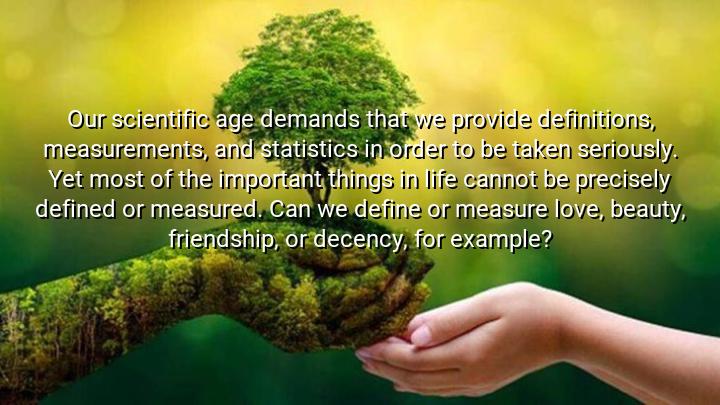




In this quote, Dennis Prager critiques the emphasis placed on definitions, measurements, and statistics in the modern scientific age. He argues that while these metrics are necessary for validation in many fields, they fall short when it comes to capturing the most important things in life. Prager points out that concepts like love, beauty, friendship, and decency cannot be easily defined or measured, yet they are integral to the human experience. This highlights the limitations of an overly scientific or quantitative approach to understanding life’s complexities.
Prager’s words suggest that the deeper, more subjective aspects of life—such as emotional connections, moral values, and personal experiences—cannot be fully captured through numbers or rigid categories. These intangible qualities often defy conventional measurements, yet they shape our lives in profound ways. Prager challenges the assumption that everything of value must be subject to objective analysis and reminds us that some of the most significant aspects of existence remain beyond the scope of scientific inquiry.
The origin of this quote comes from Dennis Prager, an American radio talk show host and writer known for his reflections on philosophy, politics, and culture. Prager often explores the tension between reason and emotion, emphasizing the importance of integrating both in our understanding of the world. His perspective on the limits of scientific analysis reflects his broader views on how human life is enriched by intangible, moral, and emotional dimensions that cannot be neatly quantified.
Prager’s quote ultimately raises a philosophical question about the nature of human experience and whether science alone can offer a complete understanding of what it means to live a fulfilling life. It encourages us to consider that while science plays a crucial role in many areas, it cannot fully encompass the richness of the human condition, especially when it comes to emotions, values, and relationships.

AAdministratorAdministrator
Welcome, honored guests. Please leave a comment, we will respond soon