

Of all the gods only death does not desire gifts.
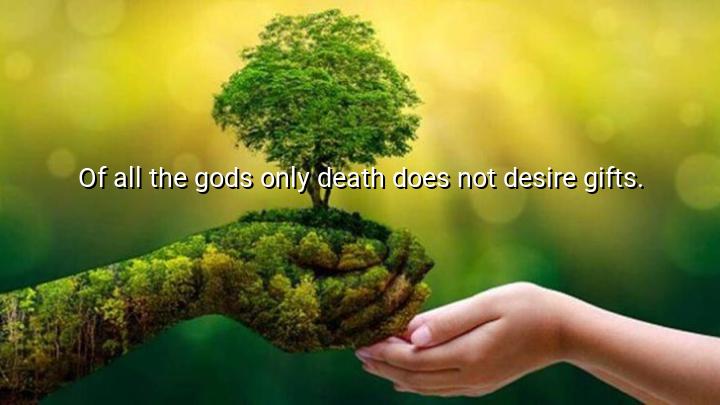




Aeschylus’ quote, "Of all the gods, only death does not desire gifts," highlights the unique and impartial nature of death in relation to the other gods in mythology. In many cultures, gods are often depicted as being in need of offerings or sacrifices to maintain their favor and power. However, death stands apart, not requiring any tribute or gifts from humans. This suggests that death, unlike the other forces of the divine, is an unavoidable constant that operates beyond human control or influence.
The quote reflects a philosophical stance on the inevitability of death. While humans may attempt to appease or negotiate with the other forces in their lives, such as fate, love, or war, death remains indifferent to such efforts. It is the one entity that transcends human attempts at appeasement. Aeschylus may be illustrating the notion that death, in its finality, does not require anything from mortals, and no amount of material offerings can change the fact of its presence.
Aeschylus, an ancient Greek playwright, often explored themes of mortality, fate, and the divine in his works. This quote reflects his recognition of the power and certainty of death as a force that is beyond human manipulation. It serves as a reminder of the transience of life and the humbling reality that no mortal can escape death, regardless of their efforts to win the favor of other gods or forces.
The origin of this quote comes from Aeschylus’ works, which often dealt with human struggles in the face of powerful, divine forces. His tragedies, like those in the Oresteia, wrestle with the themes of justice, vengeance, and the inescapability of divine will. In this context, death’s indifference to human offerings serves as a reminder of its neutrality and ultimate dominance over life. It stands as a force that neither seeks nor can be swayed by human desires.

AAdministratorAdministrator
Welcome, honored guests. Please leave a comment, we will respond soon