

Now they have come to the place where their faith can no longer feed on the bread of repression and violence. They ask for the bread of liberty, of public equality, and public responsibility. It must not be denied them.
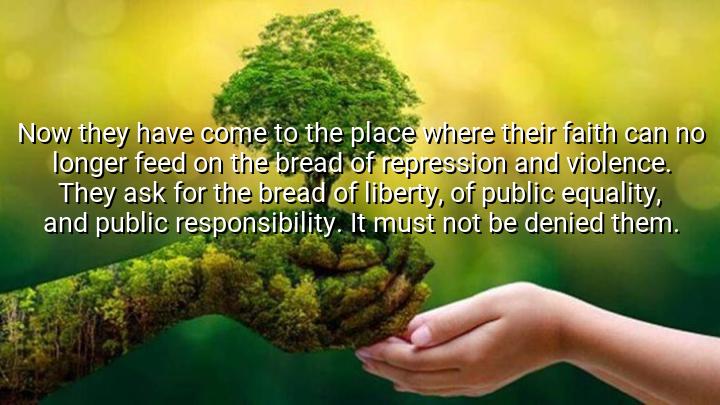




In this quote, Mordecai Wyatt Johnson speaks to a moment of awakening and demand for freedom and equality. He describes a group of people who, after enduring repression and violence, can no longer accept the sustenance of oppression. Instead, they now hunger for the "bread of liberty," symbolizing their desire for justice, public equality, and public responsibility. The statement calls for recognition of their legitimate needs and demands, asserting that these cannot be denied any longer.
The origin of this quote reflects the struggles of marginalized groups, particularly African Americans, during the time when Johnson was active in the civil rights movement. As a prominent pastor and civil rights leader, Johnson was deeply involved in advocating for the rights of African Americans in the mid-20th century, especially during the era of institutionalized segregation. His words highlight the transition from passive suffering to active resistance and the call for freedom and equality that defined the civil rights era.
Johnson's use of the metaphor of bread connects the idea of sustenance to the basic human rights that every individual deserves. The bread of repression represents the harmful, restrictive forces that keep people in a state of subjugation, while the bread of liberty symbolizes the sustenance of democracy and human dignity. His statement advocates for the end of racial injustice and the beginning of a society where equality and responsibility are paramount.
Ultimately, Johnson’s quote emphasizes the idea that the struggle for equality is not only a fight for rights but also a moral imperative. He underscores the urgency of granting people what they rightfully deserve: freedom, equality, and a voice in the public sphere. His words serve as both a call to action and a reminder that the demands of the oppressed should not be ignored or postponed.

AAdministratorAdministrator
Welcome, honored guests. Please leave a comment, we will respond soon