

Nothing will see us through the age we're entering but high consciousness, and that comes hard. We don't have a good, modern myth yet, and we need one.
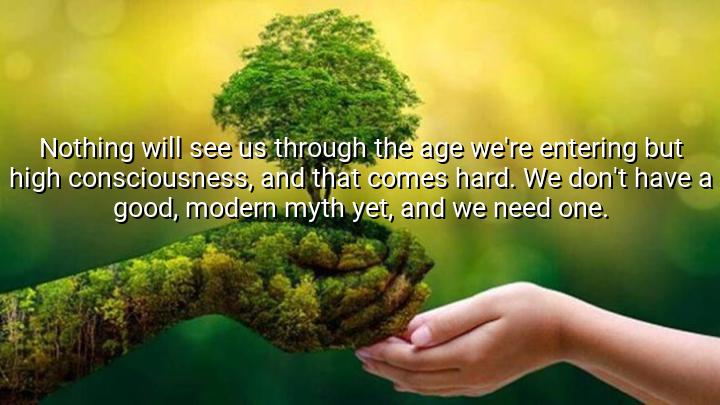




In this quote, Robert Johnson, an influential American blues musician, reflects on the challenges of the modern world and the need for a higher consciousness to navigate the complexities of the age we are entering. He suggests that as society moves forward, the key to overcoming the difficulties ahead lies in the development of a deeper awareness or consciousness, which requires significant effort to attain. This higher consciousness, in Johnson's view, is not easily achieved and involves a shift in how individuals understand themselves and the world around them.
Johnson also points out that modern society lacks a unifying myth that can provide guidance and meaning in the way traditional myths or stories once did. In earlier times, myths helped people understand their place in the world and gave them a sense of purpose. However, according to Johnson, in the contemporary age, we have not yet created a myth that can adequately reflect our current struggles and aspirations. This absence of a modern myth leaves a void in collective understanding, making it harder for people to find direction and meaning in their lives.
The origin of this quote comes from Johnson’s observations of the changing landscape of society, particularly during the 20th century, when traditional systems of belief and understanding were being challenged. As a musician deeply connected to the cultural and spiritual movements of his time, Johnson recognized the need for a shift in collective consciousness to cope with the uncertainties and rapid changes that characterized modern life. His work in music and his philosophical reflections reflect his deep concern with the direction of society.
Ultimately, Johnson’s words emphasize the idea that spiritual growth and collective understanding are crucial for navigating the challenges of modernity. Without a modern myth to unite and inspire people, Johnson believes that society struggles to find meaning and direction. His call for a higher consciousness encourages individuals to look beyond the material and superficial aspects of life and seek a deeper, more meaningful understanding of their place in the world.

HNHong Nghi
What strikes me is the longing in this quote—for clarity, cohesion, and inner evolution. It’s like Johnson is warning that intelligence alone won’t save us; we need wisdom too. And that makes me wonder: do we mistake knowledge for consciousness? Maybe our new myth needs to help us reconnect to awe, mystery, and our shared humanity—something that inspires not just thinking, but transformation.
HTPham Huyen Tran
This quote really speaks to the gap between our technological advancement and our spiritual or emotional maturity. We’ve built amazing tools, but have we built ourselves? The idea of ‘high consciousness’ as the only way forward feels daunting. How do we cultivate that on a mass scale, when most systems—education, media, politics—don’t reward inner development? It feels like we need a revolution of the soul, not just new policies.
LPTuong Vi Le Pham
I feel a kind of existential concern reading this. If Johnson’s right and we lack a guiding myth, then are we just improvising our way through a chaotic world? It makes me think about how modern society often mocks myth and spirituality as outdated. But maybe we need myth not as superstition, but as metaphor—a collective map of values and purpose. Could art, music, or literature offer that in a new form?
NHDOAN HO NGOC HAN
There’s something incredibly poetic and urgent in this quote. It speaks to a hunger for meaning, for a narrative that binds us together as we face climate change, AI, and spiritual fragmentation. The idea that myths are not just old stories but living frameworks really resonates. Are we currently living through the breakdown of old myths and the messy birth of a new one? That’s both terrifying and exciting.
NPnga pham
Johnson’s words make me wonder: what does ‘high consciousness’ actually mean in practical terms? Is it self-awareness, moral clarity, emotional intelligence—or something even deeper? And why does it come so hard? Maybe because we live in a culture that prioritizes distraction over reflection. If we don’t collectively elevate our consciousness, are we doomed to repeat cycles of destruction, even with all our progress?