

No one can avoid death; it is inevitable. Therefore, I should create in my mind a kind of willingness and accepting for that event without any fear.
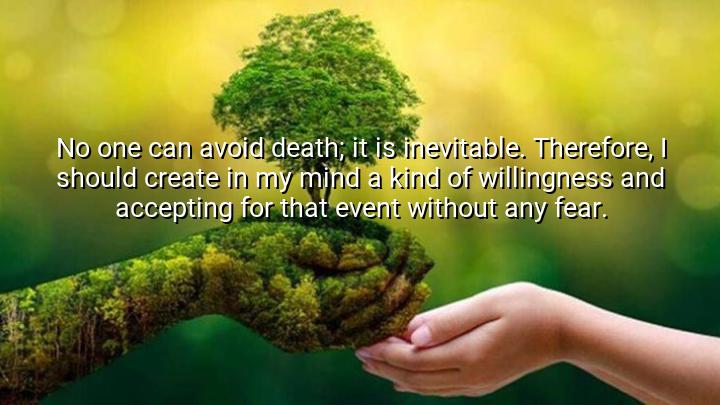




The quote "No one can avoid death; it is inevitable. Therefore, I should create in my mind a kind of willingness and accepting for that event without any fear." by Lobsang Tenzin reflects a philosophical and spiritual approach to the concept of death. Tenzin suggests that since death is an inevitable part of the human experience, it is important to cultivate an attitude of acceptance and willingness towards it rather than fear. His perspective aligns with many Eastern philosophies, particularly Buddhism, where death is viewed as a natural part of the cycle of life, and cultivating a calm, accepting attitude towards it is seen as essential for inner peace.
The origin of this quote lies in Lobsang Tenzin's background as a spiritual teacher or monk, likely influenced by his Buddhist training. In Buddhism, the notion of impermanence is central, and practitioners are encouraged to meditate on the inevitability of death to help free themselves from the fear of it. Tenzin's words reflect this teaching, suggesting that instead of resisting the idea of death, one should prepare mentally and emotionally by cultivating a sense of equanimity and understanding.
By focusing on willingness and acceptance, Tenzin encourages individuals to adopt a more peaceful mindset when thinking about death. The fear of death often arises from attachment and the inability to accept the natural course of life. In this quote, he suggests that by preparing the mind and accepting death as a part of life's journey, one can achieve a sense of freedom from the fear that typically accompanies it.
Ultimately, this quote emphasizes inner peace and the importance of mental preparation in facing life's inevitable end. Tenzin's philosophy encourages a shift in perspective from viewing death as something to be feared to seeing it as an essential and natural part of existence. By accepting death without fear, individuals can live more fully and mindfully, free from the anxiety that often surrounds the idea of mortality.

AAdministratorAdministrator
Welcome, honored guests. Please leave a comment, we will respond soon