

No, I don't believe in genius. I believe in freedom. I think anyone can do it. Anyone can be like Rembrandt.
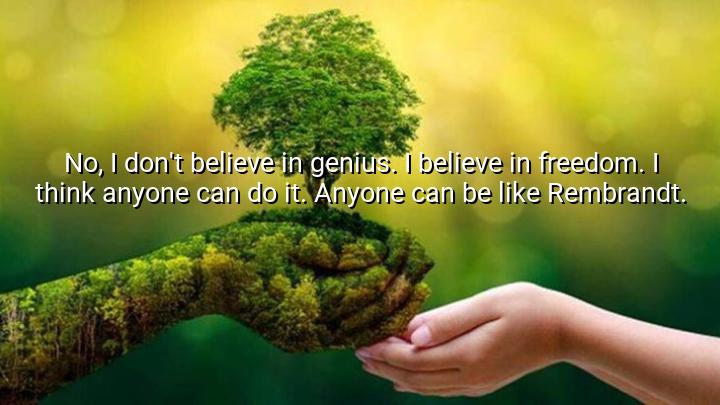




The quote "No, I don't believe in genius. I believe in freedom. I think anyone can do it. Anyone can be like Rembrandt" by Damien Hirst challenges the traditional notion of genius as an innate or exclusive gift. Hirst is suggesting that true creativity and success are not determined by some mysterious, innate talent, but by the freedom to express oneself and the opportunities available to anyone willing to pursue their passions. In this sense, Hirst advocates for the idea that anyone, regardless of their background or natural gifts, can achieve greatness through the freedom to explore their abilities.
The origin of this quote comes from Hirst's views on art and creativity, particularly as an artist known for challenging conventional ideas in the art world. As a leading figure in the Young British Artists (YBA) movement, Hirst often emphasized the idea that art is accessible to everyone, not just a select few with genius. This quote reflects his belief that freedom—the ability to create, innovate, and explore—is more important than being born with special gifts or talent. Hirst’s own work, which often blends traditional techniques with contemporary themes, reflects his belief in breaking boundaries and redefining art.
By referencing Rembrandt, one of the greatest artists in history, Hirst is making a point that anyone can achieve remarkable things, regardless of their starting point. He is advocating for equality in the opportunity to create and succeed, emphasizing that with the right freedom to explore and express oneself, anyone can produce work that resonates with lasting impact. Hirst’s message is that art is not limited to the select few deemed "geniuses," but is open to all who are free to pursue their creativity.
Ultimately, Hirst’s quote promotes a more inclusive view of creativity and achievement, one that is centered around the idea of freedom rather than talent or status. It encourages individuals to embrace their potential, knowing that with the freedom to create and the will to pursue it, they too can produce extraordinary work.

AAdministratorAdministrator
Welcome, honored guests. Please leave a comment, we will respond soon