

No economy can succeed without a high-quality workforce, particularly in an age of globalization and technical change.
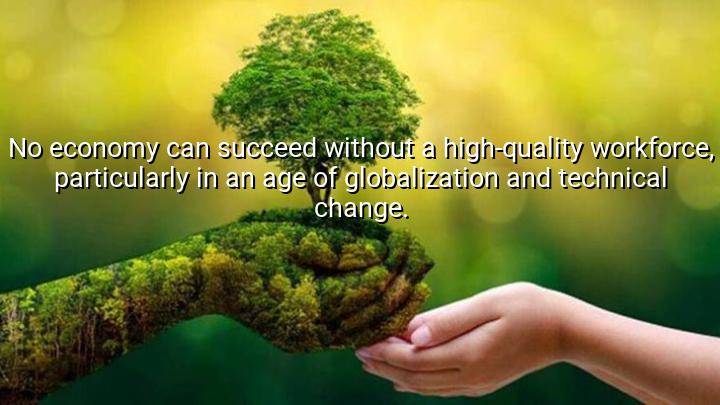




Ben Bernanke’s quote, "No economy can succeed without a high-quality workforce, particularly in an age of globalization and technical change," emphasizes the crucial role that a skilled and educated labor force plays in the success of a nation's economy. Bernanke argues that in today’s rapidly changing world, where globalization connects markets and industries worldwide, and technical change drives innovation and competition, the need for a highly capable workforce is more important than ever. Without this, countries may struggle to maintain or improve their economic standing.
The quote highlights how the demands of the modern economy are shifting. In the past, industries could thrive with less focus on education and skill development. However, in the face of globalization—which increases competition between nations—and the rapid pace of technological advancements, economies must have workers who are not only adaptable but also skilled in new technologies and innovative processes. A high-quality workforce is seen as the cornerstone of long-term economic growth and global competitiveness.
Ben Bernanke, an American economist and former Chairman of the Federal Reserve, is known for his research on monetary policy, financial systems, and the role of education in economic development. His perspective on the importance of a skilled workforce ties into broader discussions on economic policy, where access to education and training is viewed as a key driver of both individual prosperity and national economic success.
In essence, Bernanke’s quote emphasizes the interconnectedness between education, a skilled workforce, and the ability of nations to thrive in an increasingly complex global economy. It highlights that the future of economic success depends not just on financial or material resources, but on investing in human capital—ensuring that the labor force is well-equipped to meet the challenges of globalization and technological change.

THtanh hyunh
What I find compelling is how this quote emphasizes the *quality* of the workforce, not just the size. In an age where AI can do repetitive tasks, creativity, critical thinking, and emotional intelligence become even more valuable. But are our schools and universities really fostering those skills? Or are we still preparing people for a job market that’s already disappeared?
VNLuu Viet Nam
This makes me think about the responsibility of the private sector. Are companies investing enough in training their own employees, or are they just hunting for ready-made talent? Maybe the problem isn’t just education systems, but corporate short-termism. If workforce quality is vital, shouldn’t businesses play a bigger role in shaping it beyond internships and university partnerships?
NDNguyen Ngoc Diep
Reading this, I think of how globalization has created both opportunities and vulnerabilities. A highly skilled workforce can harness global markets, but a poorly trained one is at the mercy of outsourcing and automation. It makes me think: how can nations foster a workforce that’s both tech-savvy and adaptable without deepening inequality? Is universal access to quality education even achievable anymore?
DVDat Vu
This quote highlights a growing divide between economies that invest in human capital and those that don’t. In a globalized world, competition isn't just between companies, but between entire labor markets. What happens to countries that neglect education or vocational training? Are they doomed to stagnation or dependency? It’s a sobering reminder that workforce quality determines national resilience.
PAPham Phuong Anh
I agree with Bernanke—talent is the new currency. But I’m concerned about the growing skills gap. As automation and AI spread, how do we ensure that people who are displaced are not left behind? It's not just about economic productivity; it’s about fairness and opportunity. Shouldn't workforce development be treated as a national priority with the same urgency as defense or infrastructure?