

New Age values are conscious evolution, a non-sectarian society, a non-military culture, global sharing, healing the environment, sustainable economies, self-determination, social justice, economic empowerment of the poor, love, compassion in action, going beyond religious fundamentalism, going beyond nationalism-extreme nationalism, culture.
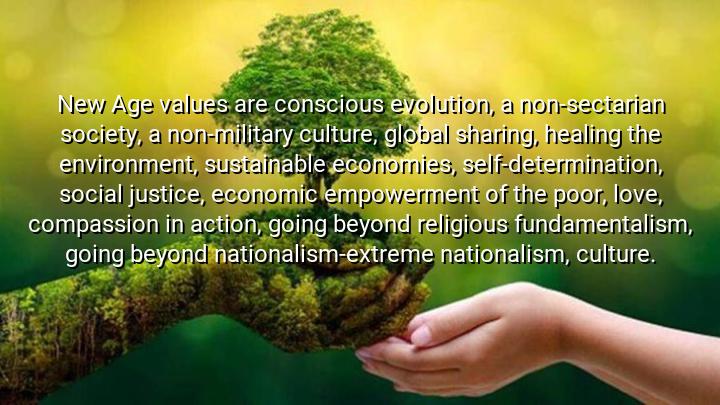




The quote, "New Age values are conscious evolution, a non-sectarian society, a non-military culture, global sharing, healing the environment, sustainable economies, self-determination, social justice, economic empowerment of the poor, love, compassion in action, going beyond religious fundamentalism, going beyond nationalism-extreme nationalism, culture," comes from Deepak Chopra, an Indian-American author and advocate for alternative medicine and spirituality. In this statement, Chopra outlines the values he associates with the New Age movement, a spiritual and philosophical movement that gained prominence in the late 20th century.
Chopra’s emphasis on "conscious evolution" speaks to the belief in the potential for humanity to consciously evolve toward greater spiritual and social awareness. The idea of a non-sectarian society reflects a desire to move beyond rigid religious boundaries and embrace a more inclusive, unified worldview. By promoting global sharing and healing the environment, Chopra advocates for a society where people cooperate across national and cultural lines to solve global problems such as poverty and environmental degradation.
The quote also touches on social and economic issues, such as sustainable economies, self-determination, and the economic empowerment of the poor. Chopra envisions a world where economic systems prioritize equity, justice, and the well-being of all people, especially the disadvantaged. This contrasts with traditional systems that often prioritize profit over people, advocating instead for social justice and a compassionate approach to governance and social structures.
Ultimately, Chopra’s quote advocates for a holistic and inclusive vision of global society, one that moves beyond religious fundamentalism, extreme nationalism, and divisive ideologies. He calls for a shift toward a more compassionate, sustainable, and socially just world. The values he outlines encourage individuals and societies to prioritize love, understanding, and global cooperation in addressing both social and environmental challenges.

KVLe Tran Khanh Vy
This quote presents an optimistic future grounded in love and conscious evolution, but it also raises questions about implementation. How can societies transition from military cultures to peaceful ones? Is it more effective to focus on grassroots movements or top-down policy changes? What challenges might arise in promoting such New Age values globally?
NQNguyen Thi Nhu Quynh
Chopra’s mention of ‘global sharing’ and ‘going beyond extreme nationalism’ is especially relevant in a world marked by rising nationalism. I wonder how feasible it is to foster a global mindset when many countries prioritize their own interests. What cultural shifts or educational reforms might be needed to encourage this broader sense of humanity?
BYNgo Hoang Bao Yen
The concept of ‘economic empowerment of the poor’ alongside sustainable economies is crucial and often overlooked. Chopra’s vision seems to suggest that true progress includes equity and environmental care. How do you think societies can prioritize both economic development and sustainability without sacrificing either? What role does compassion play in creating such balance?
HHMinh Huyen Hoang
This quote touches on a comprehensive set of ideals that challenge many current systems. It makes me think about the tension between spiritual growth and political realities. How does one balance personal evolution with the need for systemic change? Are New Age values more about individual transformation, or can they also fuel collective action?
VNVanthu Nguyen
I appreciate the emphasis on compassion, social justice, and environmental healing in this quote. It’s a hopeful framework for addressing global issues. But I’m curious about how ‘going beyond religious fundamentalism and nationalism’ can be realistically achieved without alienating those who hold strong beliefs. Is there a middle ground where these values can coexist with diverse identities?