

Nature has made men free and equal. The distinctions necessary for social order are only founded on general utility.
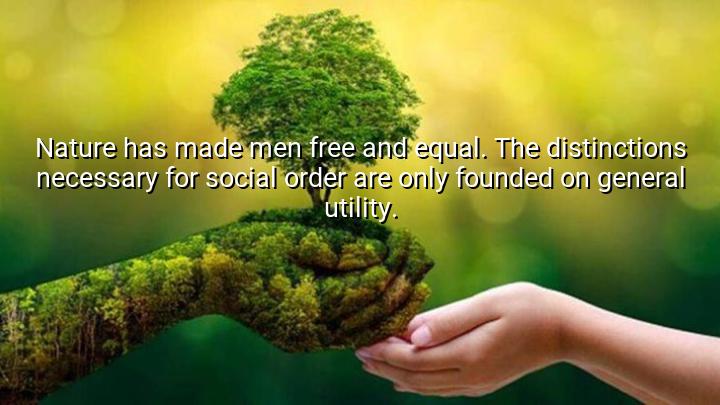




In this quote, Marquis de Lafayette emphasizes the inherent freedom and equality of all individuals, as granted by nature. Lafayette is asserting that every human being is born with the same basic rights and freedoms, and these natural qualities should not be diminished by artificial distinctions or inequalities. However, he acknowledges that while equality exists by nature, social order requires certain distinctions, but these distinctions should only be made when they serve the general utility or the greater good of society.
Lafayette’s statement reflects his belief in the natural rights of individuals, an idea influenced by the Enlightenment thinkers, such as John Locke and Jean-Jacques Rousseau, who argued that all men are born with inalienable rights. His assertion that distinctions in society should be based on their usefulness to the common good is an early argument for meritocracy—a system where individuals are recognized and rewarded based on their abilities and contributions, rather than arbitrary factors like birth or social status.
The quote highlights Lafayette’s broader political philosophy that aligns with the principles of the French Revolution and the American Revolution, both of which he played pivotal roles in. Lafayette was a strong advocate for democracy, individual rights, and equality, and his statement underscores the importance of balancing individual freedoms with the practical needs of an organized society. He believed that any social distinctions should be justified by their ability to contribute to the welfare and stability of the state, not by entrenched privilege or inequality.
Ultimately, Lafayette’s quote calls for a society that recognizes the inherent equality of all people, with distinctions made only when they are necessary for maintaining social harmony and serving the greater good. It suggests that while order is required in any functioning society, it should never come at the expense of the freedom and equality of individuals, and any distinctions should be grounded in rational utility, not arbitrary or unjust power dynamics.

AAdministratorAdministrator
Welcome, honored guests. Please leave a comment, we will respond soon