

Nature gives you the face you have at twenty; it is up to you to merit the face you have at fifty.
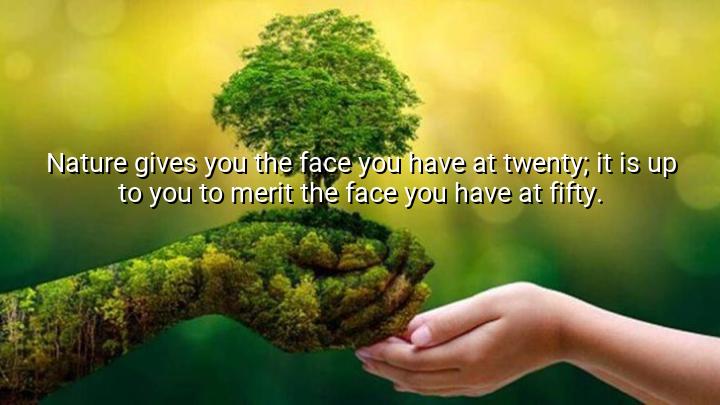




In this insightful quote, Coco Chanel emphasizes the role of personal choices and self-care in shaping the face we present to the world as we age. She acknowledges that nature provides us with the genetic foundation of our appearance when we are young, giving us the face we have at twenty. However, she suggests that as we age, it is up to us to merit the appearance we have at later stages in life, such as at fifty, through the way we live, care for ourselves, and maintain our physical and emotional health.
Chanel’s words highlight the idea that while youth is a gift of nature, the way we age is a reflection of the life choices we make. As we grow older, our habits, attitudes, and efforts to take care of our body—whether through diet, exercise, or mental well-being—affect how we look. The quote implies that aging gracefully is not just about being passive to the process but actively engaging in practices that enhance beauty and well-being.
Chanel, who was renowned for her sense of style and elegance, likely intended to stress the importance of self-discipline and self-respect in how we present ourselves to the world. This could involve more than just cosmetic or physical care but also the way we cultivate inner peace, confidence, and attitude as we age. The concept of "meriting" one's appearance suggests that it’s a reward for how we choose to live and carry ourselves over the years.
Ultimately, Chanel’s quote serves as a reminder that aging is not merely a natural process dictated by time but is also influenced by our decisions and efforts. Our appearance at later stages in life is a combination of nature and nurture, with our actions over time playing a significant role in shaping how we look and feel as we age. It encourages us to take ownership of the face we present to the world as we grow older.

TNnguyen thi thanh nhan
Chanel’s statement feels like a challenge to live authentically and intentionally. If our faces truly reflect our lived experience, what does that say about the value of inner peace, gratitude, and resilience? I’d love to hear others’ interpretations—do you see this quote as motivational or judgmental? And how do you think this idea intersects with modern beauty standards?
TMLe Phung Tuyet Mai
There’s something deeply philosophical about this quote, almost like it’s asking us to take accountability for our life journey. But it also raises a concern—does it unintentionally put pressure on people to ‘look good’ as a reflection of moral or emotional success? Can aging gracefully really be a merit, or is that just another societal expectation disguised as wisdom?
THPham thuy hang
This quote makes me think about responsibility and self-care—not just in appearance, but in how we age emotionally and spiritually. But is it fair? So much of how we look in later life is tied to factors outside of our control. Still, I can’t help but wonder: does our face at fifty reflect not just what we’ve done, but who we’ve become?
OTOanh Ta
I love this idea—it's empowering in a way. It tells me that our character, mindset, and how we live our lives ultimately shape how we’re perceived later in life. But I’m also curious: how do genetics or socioeconomic factors fit into this? Can someone who’s had a hard life still 'merit' a beautiful face at fifty if they’ve carried themselves with dignity and grace despite challenges?
NQPHAM NGOC NHU QUYNH
This quote intrigues me because it suggests that our faces tell the story of our lives—not just through aging, but through the choices we've made and the emotions we've carried. Do stress, kindness, and joy really leave visible traces over time? I wonder how much of what we ‘earn’ in our appearance comes from internal states rather than external factors like skincare or health routines. Thoughts?