

My mother encouraged me to be artistic. It was written in a contract at an early age that I would be an artist.
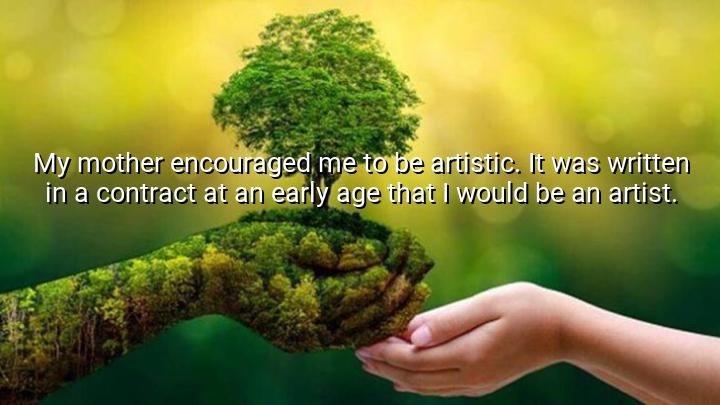




In this quote, Kurt Cobain, the lead singer and guitarist of Nirvana, reflects on how his mother played a significant role in shaping his artistic path. Cobain suggests that from a young age, his mother encouraged him to pursue artistic expression, perhaps in a way that felt almost predetermined. The phrase "written in a contract" metaphorically implies that it was expected or destined for him to become an artist, with an early influence pushing him toward a creative career.
Cobain’s statement highlights the pressure he may have felt growing up, with his mother’s encouragement framing his future as an artist in a very concrete way. While this kind of support can be positive, Cobain’s use of the word “contract” might also indicate that he felt some sense of obligation or duty to meet those expectations. This early push to focus on the arts likely influenced his later creativity, but it may have also created a sense of responsibility to conform to a certain path in his career.
The origin of this quote comes from Cobain’s reflections on his upbringing and how his family shaped his identity. As a member of one of the most influential rock bands of the 1990s, Cobain often spoke about the difficulties of growing up in a broken home, but he also recognized the importance of his mother’s encouragement in developing his musical and artistic sensibilities. His struggle with fame and the pressure to live up to public expectations can be seen as an extension of this early contract of artistic ambition.
Ultimately, Cobain’s words reveal how the influence of family and early expectations can guide a person’s creative journey, sometimes with both positive and negative effects. His artistic identity, shaped by his mother’s encouragement, became a central part of who he was, but also a source of inner conflict as he navigated the pressures of fame and personal struggle. The quote reflects both the privilege and burden of being pushed toward a predetermined path, and how that early influence shaped his artistic legacy.

NTai hoa nguyen thi
Such an intriguing line. It walks the line between gratitude and quiet rebellion. Did Cobain feel empowered by that early artistic direction, or did it become a box he couldn’t escape? We often praise parents for fostering creativity, but what happens when that identity is formed too rigidly, too young? How much choice did he feel he had? It’s a quote that opens up a thousand questions about freedom, love, and destiny.
NNTran Diep Nhu Ngoc
This makes me think about how rare and valuable it is to have a parent encourage creativity, especially in a world that often prizes practicality. But Cobain’s choice of the word 'contract' feels heavy. Did he feel trapped by that identity? Was he allowed to be more than just ‘the artist’? It makes me reflect on how early labels can shape, and sometimes limit, a person’s sense of possibility.
Aanhtuyet
There’s a deep poignancy in how Cobain frames his artistic path—like it was written before he had a say in it. Was this maternal support or unspoken expectation? It raises the question: how do we distinguish between nurturing a talent and scripting a life? Sometimes, even encouragement can morph into quiet pressure, especially for sensitive, introspective souls like Cobain seemed to be.
PHPhuong Hung
This quote hits me personally. It makes me think of how early encouragement (or the lack of it) defines whether we see ourselves as creative or not. Cobain makes it sound like his destiny was locked in from childhood. But can that sense of inevitability stifle self-discovery? Was he ever given the freedom to just be, rather than perform a role someone else imagined for him?
MHmy ha
I love how this quote speaks to the role of parental influence in shaping creativity. Having someone believe in your artistic nature from a young age is powerful. But I also wonder—did that belief become a burden? Cobain’s life was filled with inner conflict. Could the ‘contract’ he talks about have been both a gift and a source of pressure to live up to something predefined?