

My experience of living with people of diverse religions and cultures taught me that one will never be at peace with the other if one is at war with oneself.
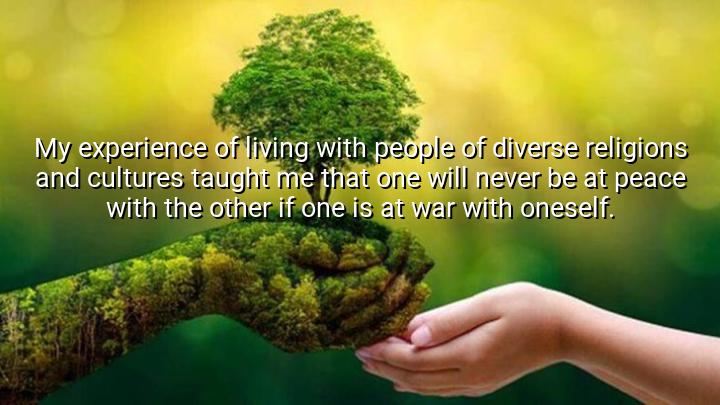




The quote "My experience of living with people of diverse religions and cultures taught me that one will never be at peace with the other if one is at war with oneself" by Tariq Ramadan speaks to the importance of inner peace in fostering harmony and understanding with others. Ramadan, a prominent Islamic scholar and author, reflects on his experiences living among people from a wide variety of religions and cultures. His insight emphasizes that before one can achieve peace with others, one must first cultivate peace within themselves. Internal conflict, whether due to personal doubts, prejudices, or unresolved issues, can prevent individuals from truly embracing diversity and building bridges with others.
Ramadan’s point is that self-awareness and self-acceptance are crucial in developing a compassionate and open mindset toward others. When individuals are at war with themselves, whether due to identity struggles, conflicting beliefs, or unresolved emotional challenges, they project these inner conflicts outward, often leading to misunderstanding, division, and tension with those around them. Inner peace helps us approach others with empathy, openness, and understanding, which are essential for peaceful coexistence in a world filled with diverse people and perspectives.
By mentioning his personal experience of interacting with individuals from different faiths and backgrounds, Ramadan underscores that peaceful coexistence is rooted in mutual respect and the ability to accept not only others but also ourselves. When we embrace our own complexity and accept our own differences, we become more equipped to accept and appreciate the diversity of others.
Ultimately, Ramadan’s quote stresses that peace is not just about external agreements or tolerance but about the internal work that individuals must do to heal and reconcile their own conflicts. This internal peace is a prerequisite for creating a more inclusive and understanding world where people of different backgrounds can live together harmoniously.

AAdministratorAdministrator
Welcome, honored guests. Please leave a comment, we will respond soon