

Minds ripen at very different ages.
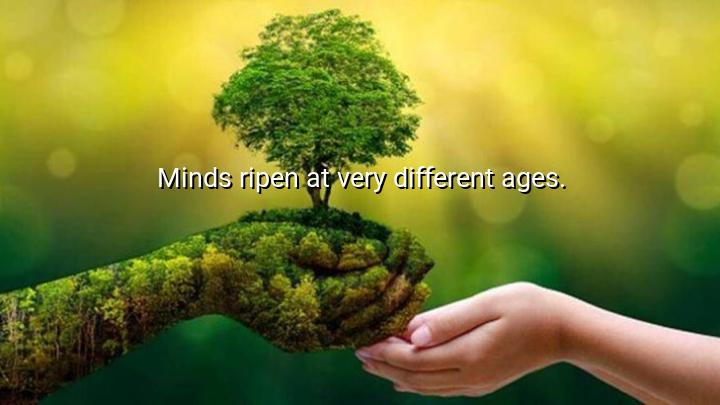




The quote "Minds ripen at very different ages" by Stevie Wonder highlights the idea that intellectual and emotional growth do not occur according to a set timeline. Wonder, an influential American singer, songwriter, and activist, uses this statement to convey that the development of the mind and wisdom is a highly individual process, not necessarily tied to one's age. While some people may achieve great insight or maturity at a young age, others may not experience this level of intellectual ripening until later in life.
Wonder’s quote challenges the conventional notion that youth is synonymous with learning and growth while older people are seen as having already achieved their peak mental state. Instead, he suggests that everyone matures at their own pace, and that wisdom and understanding often come at unexpected times. This means that a person's capacity for knowledge, creativity, or personal insight can flourish at any point in their life, depending on their experiences, environment, and personal development.
The quote also speaks to the diversity of human experience and how people grow in different ways. Just as fruits ripen at different times, minds evolve in unique ways, influenced by individual circumstances and challenges. Wonder emphasizes that intellectual and emotional growth cannot be rushed or measured by a universal standard, highlighting the importance of patience in one’s personal journey.
Ultimately, Stevie Wonder’s quote encourages a broader view of intellectual growth and maturity, suggesting that there is no single path or age at which a mind truly "ripens." It celebrates the idea that we all have the potential to continue evolving and gaining wisdom at any stage of life.

APNguyen An Phu
This quote resonates with me deeply. It reminds me that we shouldn’t judge someone’s potential based on their age alone. Intelligence, creativity, and emotional understanding can blossom unexpectedly. What if we started celebrating the diversity of mental development instead of treating it like a race? Maybe then more people would feel empowered to grow without shame or pressure. Isn’t that the real goal of education and personal evolution?
VHNgo Van Ha
I appreciate this perspective because it opens the door to lifelong learning. There’s so much pressure to 'figure it all out' in your twenties or thirties, but the truth is, some of us only find clarity or purpose much later. This quote reassures me that mental growth doesn’t expire. Do you think our current culture allows enough space for delayed or nonlinear intellectual development?
A2Vuong Anh 2012
Isn’t it fascinating how some people have life-changing ideas in their teens, while others don’t hit their stride until their sixties? This quote really underscores that genius or insight doesn’t operate on a schedule. I wonder what opportunities we miss by assuming people must 'peak' by a certain age. Shouldn’t we create environments that welcome innovation and wisdom at any stage of life?
0H09-Minh Hao
This quote makes me think about how society often equates intelligence or maturity with age, but that’s not always accurate. I've seen children who are emotionally intuitive beyond their years and adults who still struggle with basic self-awareness. How can we move beyond age-based assumptions and embrace a more individualized understanding of personal growth? Wouldn’t we be more compassionate and effective as a culture if we did?
NNhu
I really love the wisdom in this quote. It challenges the idea that there’s one 'right' timeline for learning, growing, or succeeding. Why do we pressure kids to excel early or shame adults for finding their path later in life? Everyone processes life differently, and our brains evolve at unique speeds. Shouldn’t our education systems and workplaces be more flexible to accommodate these different paces of mental development?