

Middle age is the time when a man is always thinking that in a week or two he will feel as good as ever.
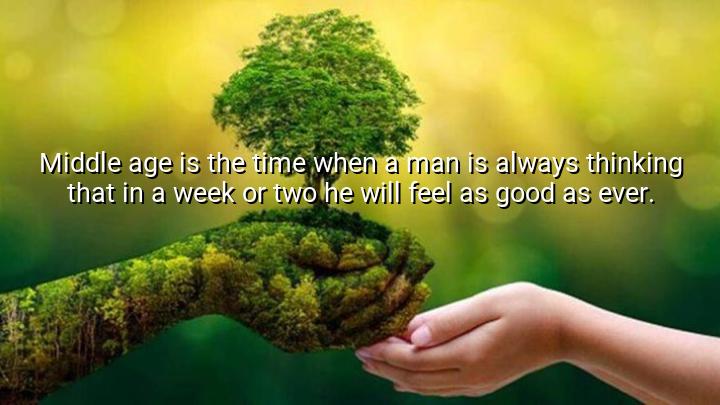




The quote "Middle age is the time when a man is always thinking that in a week or two he will feel as good as ever" by Don Marquis humorously addresses the denial and optimism often associated with middle age. Marquis, an American writer and humorist, uses this statement to reflect on how people in middle age tend to convince themselves that they will soon feel youthful and energetic again, despite the signs of aging becoming more apparent. It captures the way individuals often expect to recover their former vitality, even as the body shows the inevitable effects of time.
In middle age, many individuals experience a growing awareness of physical decline, whether it’s through changes in energy levels, health issues, or the natural signs of aging. However, the quote suggests that instead of confronting these realities, they often remain in a state of hope or denial, thinking that improvement is just around the corner. This mindset reflects an internal struggle to hold on to the youthful vigor of earlier years, even when it’s increasingly difficult to do so.
The quote also pokes fun at the optimism that often comes with aging. Middle-aged people may find themselves believing that, with a little time or effort, they can return to their previous form or well-being. This belief is common in a culture that often emphasizes youth and vitality but doesn’t always acknowledge the natural progression of aging. Marquis captures the humorous side of this delusion, suggesting that it’s part of the middle-aged experience to hold onto the hope of returning to peak health.
Ultimately, Marquis’s quote highlights the delicate balance between acceptance and denial that many people face during middle age. It humorously points out the way individuals often deceive themselves, expecting that age-related changes can be reversed in a short amount of time, even though the passage of time is often inevitable.

LHLe huy
This quote made me laugh, but then I felt a little melancholic. There’s something universally relatable about it. That lingering sense that you’re not quite at your best—but you will be, soon. It makes me think: is this part of the human condition, to always hope for renewal? Or is it something cultural, a result of society’s obsession with youth and peak performance? I’d love to know if others interpret it as hopeful or sad.
HNNguyen Hoang Nam
Does this quote suggest that middle age is defined by a permanent state of postponement? Always just waiting to feel better, stronger, younger? It’s almost poetic in its sadness. I think a lot of people end up chasing a sense of youth instead of embracing the strengths of their current stage in life. Is there value in accepting that we change, or are we wired to always long for our past vitality?
HTNguyen Hoai Thuong
What I find most interesting is the emotional layer behind this quote. It’s funny, sure, but there’s a deep undercurrent of vulnerability. It makes me wonder: why do so many people associate wellness with their youth? Is there a way to reframe our expectations so that we don't constantly look backward to feel good? Maybe middle age is less about decline and more about adjusting our definition of feeling 'as good as ever.'
TNnguyen thi nguyet
Isn’t it fascinating how middle age brings with it a quiet battle between hope and reality? I relate to this sense of always waiting for a return to your 'peak' self, as if it’s just around the corner. Do others feel this is a healthy mindset—staying optimistic—or could it lead to frustration when that bounce-back never fully comes? It seems like an emotionally charged phase of life, in both subtle and overt ways.
KL18. Tran Khanh Linh
This quote hits a bit too close to home. It really captures that sense of lingering optimism mixed with a slow realization that your body isn’t quite bouncing back like it used to. Is this just a humorous way to cope with aging, or does it reveal something deeper about denial and the resistance many people feel toward growing older? I wonder if women feel the same way in middle age, or if this mindset is more culturally tied to men.