

Middle age is the awkward period when Father Time starts catching up with Mother Nature.
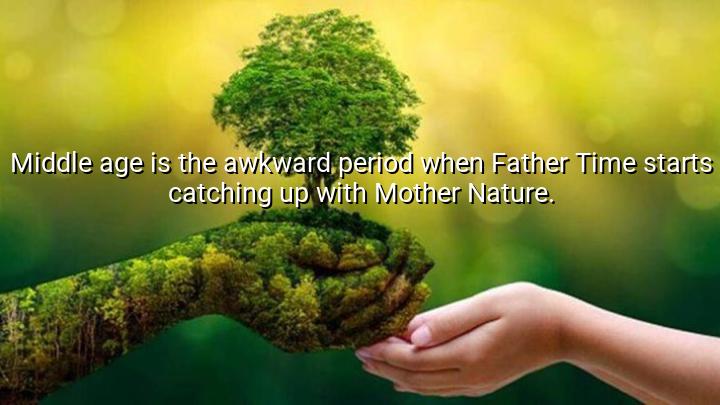




The quote "Middle age is the awkward period when Father Time starts catching up with Mother Nature" by Harold Coffin humorously captures the experience of middle age as a time when the inevitable effects of aging become more apparent. Coffin, a well-known American writer and humorist, uses the image of Father Time and Mother Nature to symbolize the conflicting forces of biological aging and the natural beauty and vitality associated with youth. In this quote, Father Time represents the passage of time, while Mother Nature represents the youthful vigor and beauty that time gradually diminishes.
In middle age, the body and mind begin to show the signs of aging, such as wrinkles, physical decline, and a slowing metabolism, which can feel like an uncomfortable shift between the youthful energy of earlier years and the reality of getting older. Coffin suggests that this is an awkward period when time starts to take its toll on the body’s natural beauty and strength, forcing individuals to reconcile with their changing appearance and capabilities. The term "awkward" highlights the discomfort and adjustment that comes with these changes.
The quote also hints at the balance between external appearance and internal changes that occur as we age. Middle age is a time when people are often caught between youthful ideals and the physical realities of aging, facing challenges with their health, appearance, and energy levels. Coffin's use of Father Time catching up with Mother Nature captures this moment of transition, where the aging process starts to become visible and unavoidable.
Ultimately, Coffin’s quote presents middle age as a period of reflection and sometimes discomfort, where the natural beauty and vitality of youth begin to fade, and the passage of time becomes more evident. It humorously acknowledges the awkwardness of this stage, as individuals come to terms with the physical and emotional shifts that define this phase of life.

NMnguyet minh
This quote makes me curious about the gendered symbolism it uses—Father Time and Mother Nature. It subtly plays on stereotypes, which is clever, but also raises questions. Are we reinforcing certain views of aging by associating it with these archetypes? Do men and women experience middle age differently because of biological factors, or is it mostly cultural conditioning? This quote opens up a surprising number of angles worth exploring.
LTLe Toan
Funny and thought-provoking—this quote uses humor to express a truth that many avoid talking about. The metaphor is lighthearted, but the underlying idea is a little sobering. Is there really a point when nature stops cooperating and time starts winning? Or is it more about how we perceive ourselves in this stage? I think it reflects our culture’s discomfort with aging more than any biological truth.
KVKha vy
This quote really captures the tension a lot of people feel as they hit middle age. You're not exactly young anymore, but you're not quite old either, and the changes—physical and emotional—start to feel more pronounced. But is it fair to describe this stage as merely 'awkward'? Couldn’t it also be a period of newfound strength, purpose, and clarity? I’d love to hear how others have embraced this transitional phase.
TMTao Thi Minh
I appreciate the wit in this quote, but I can't help but question why aging is so often painted as a battle or a burden. Is it really about losing something, or could it be seen as gaining perspective, maturity, and freedom from youthful insecurities? Perhaps the 'awkwardness' comes more from societal expectations than any inherent flaw in growing older. What if we rebranded middle age altogether?
DTPham Dinh Thien
This quote made me laugh, but also hit a little too close to home. It's clever how it personifies aging as a dynamic between two mythical figures—Father Time and Mother Nature. But it also makes me wonder: is middle age really 'awkward,' or is it just that society frames it that way? Why do we view this phase as a decline rather than a period of balance, experience, and even reinvention?