

Marriage, in its truest sense, is a partnership of equals, with neither exercising dominion over the other, but, rather, with each encouraging and assisting the other in whatever responsibilities and aspirations he or she might have.
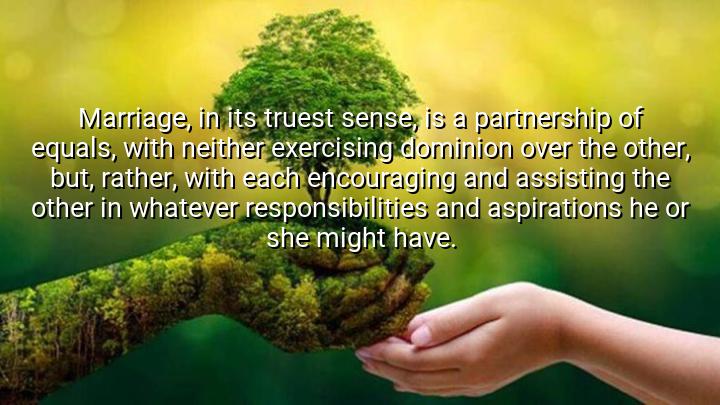




In this quote, Gordon B. Hinckley emphasizes that marriage, at its core, should be a partnership of equals. He suggests that the relationship between spouses is not about one person holding power or control over the other. Instead, a true marriage is based on mutual respect, where both individuals support and encourage one another in fulfilling their responsibilities and aspirations. Each partner plays an equal role in helping the other grow, both personally and within the relationship.
Hinckley’s words challenge traditional views of marriage that may place one partner in a more dominant role, whether socially, emotionally, or financially. By advocating for equality in marriage, he underscores the importance of a shared partnership where both individuals contribute equally, not just in practical terms but also in emotional support and personal growth. This vision of marriage promotes an atmosphere where both partners feel empowered to pursue their goals and dreams, knowing they have the full backing of the other.
The origin of this quote lies within Hinckley’s broader teachings on family and relationships, especially as a leader in The Church of Jesus Christ of Latter-day Saints (LDS). Throughout his ministry, Hinckley often spoke about the importance of love, respect, and equality in marriage. His perspective reflects a belief in the spiritual and emotional unity of a marriage, where both partners are seen as equally important and worthy of support and consideration.
Ultimately, Hinckley’s quote calls for a vision of marriage where both partners work together as equals, helping one another achieve their fullest potential. It promotes the idea that a healthy marriage is based on cooperation, understanding, and shared goals, allowing both individuals to flourish within the relationship.

AAdministratorAdministrator
Welcome, honored guests. Please leave a comment, we will respond soon