

Many of us saw religion as harmless nonsense. Beliefs might lack all supporting evidence but, we thought, if people needed a crutch for consolation, where's the harm? September 11th changed all that.
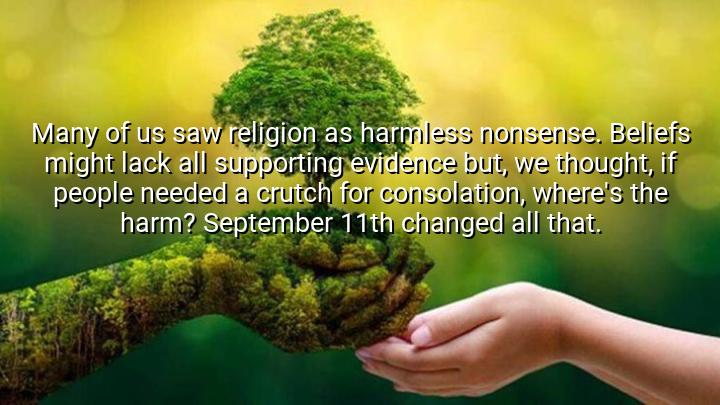




In this quote, Richard Dawkins reflects on the shift in perspective many people had toward religion prior to the September 11th attacks. He describes how religion was often viewed as "harmless nonsense"—something that, although lacking evidence or logical support, could still provide comfort or consolation to those who believed in it. This viewpoint suggests that as long as religion did not directly cause harm or interfere with others, it was considered innocuous, even if its truth claims were seen as unsubstantiated.
However, Dawkins points to the September 11th attacks as a pivotal moment that changed this perception. The terrorist attacks, which were carried out by individuals motivated by a radical interpretation of Islam, brought the consequences of religious extremism and violence to the forefront of global consciousness. For Dawkins, this event demonstrated that religion, far from being harmless, could serve as a dangerous motivator for destructive actions, with far-reaching consequences for society. The attacks shattered the belief that religion could be confined to a personal, private matter without causing harm to others.
Dawkins uses this quote to highlight his broader critique of religion, which he has expressed in many of his writings. As a staunch atheist and critic of religious belief, Dawkins argues that the lack of evidence for religious claims does not justify their continued influence, especially when these beliefs can lead to violence, intolerance, or social division. His statement reflects his view that religious ideologies, when taken to extremes, are not just harmless beliefs but can have real-world and harmful consequences for society.
The origin of this quote is from Richard Dawkins, a prominent evolutionary biologist and atheist advocate known for his outspoken criticism of religion and his defense of scientific reasoning. The quote appears in his work, where he discusses the dangers of religious belief and the importance of skepticism and evidence in forming our worldviews. Dawkins’ perspective on religion was shaped by his scientific background, and he has frequently argued that a rational, evidence-based worldview is preferable to belief systems that rely on faith without supporting evidence.

AAdministratorAdministrator
Welcome, honored guests. Please leave a comment, we will respond soon