

Loving someone liberates the lover as well as the beloved. And that kind of love comes with age.
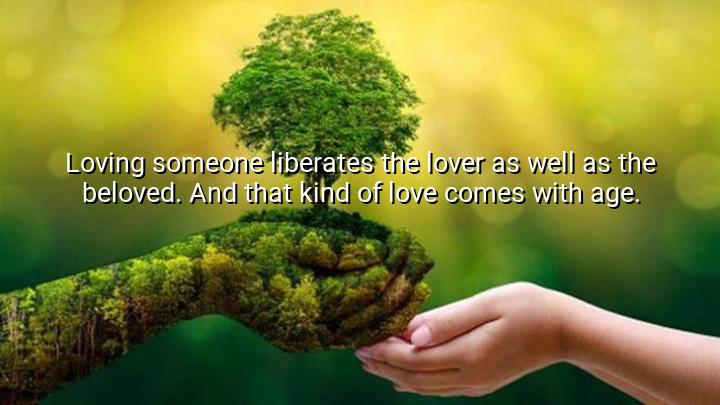




Maya Angelou’s quote, "Loving someone liberates the lover as well as the beloved. And that kind of love comes with age," highlights the profound, transformative power of love. Angelou suggests that true love is not just about what one person feels for another, but how it can free both the person giving love (lover) and the one receiving it (beloved). This type of love allows both individuals to grow, understand each other, and break free from personal limitations, creating a more fulfilling relationship. It emphasizes that love has the capacity to liberate both parties, fostering mutual growth and deeper connection.
The second part of the quote, "And that kind of love comes with age," speaks to the idea that such a deep, freeing form of love is not something one can easily experience in youth. With age, people gain more wisdom, self-awareness, and understanding of what love truly entails. Angelou reflects the idea that the deeper, more mature love comes after life experiences have shaped a person’s ability to love unconditionally and selflessly. Age allows for a greater appreciation of love’s complexity and power.
Maya Angelou, a celebrated poet, memoirist, and civil rights activist, often explored themes of love, freedom, and personal growth in her works. Her own experiences with love, including overcoming hardship and finding deeper emotional connections later in life, influenced her understanding of love's transformative power. This quote reflects her belief in personal liberation through love, which becomes more significant as one grows older and gains perspective.
In essence, Angelou’s quote suggests that love evolves with age, and as we grow older, we become more capable of experiencing a type of love that liberates us from our fears, insecurities, and limitations. It encourages us to embrace love not as a fleeting feeling but as a powerful force that can bring about deep, transformative change in both the lover and the beloved.

NANguyen Anh
I absolutely love this perspective. It feels like a deep truth that only someone who's lived through love's many forms could express. But I wonder—how do you know when you're experiencing this liberating kind of love versus something more conditional? Is it about how secure you feel, or how much you want the other person to thrive even without you? And if age brings this wisdom, is it more about experience than actual years?
VHNguyen Phi Viet Hung
This quote brings me comfort, but also raises questions. If this kind of love comes with age, then how do we nurture it intentionally? Do people have to go through painful relationships to arrive at this kind of freedom, or can we be taught early on what real love is? I think our culture romanticizes drama and passion more than growth and peace, which makes this kind of liberating love feel almost revolutionary.
ACTrong Anh Can
Can love really liberate both people involved? I think it can—but it’s rare, and often misunderstood. So many relationships are based on dependence or fear of loss, especially early in life. Maybe that’s what Maya Angelou is getting at—that love matures as we do. Still, I’m curious: are there examples of young couples who embody this kind of love? Or is it something we can only recognize in hindsight, after a long journey?
GNluong gia nghi
This really made me pause. I love the idea that love is freeing, not constraining—but it makes me reflect on how much of my past love was actually about control or validation. Does getting older inherently bring more selflessness to love, or do we just get tired of emotional drama? Maybe age allows us to separate love from ego. I’d like to believe you don’t have to be old to love that wisely, though.
NANgao ADG
I find this quote both inspiring and a little bittersweet. If that kind of liberating love only comes with age, does that mean we’re destined to fumble through love in our youth? Or can we learn to love freely and maturely earlier in life if we’re conscious of it? I wonder what specific life experiences actually nurture that kind of growth. Is it heartbreak, self-discovery, or maybe witnessing others love without possession or fear?