

Lord save us all from old age and broken health and a hope tree that has lost the faculty of putting out blossoms.
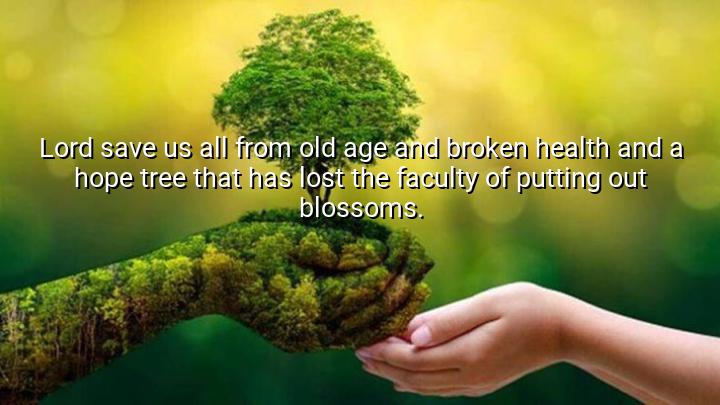




The quote, "Lord save us all from old age and broken health and a hope tree that has lost the faculty of putting out blossoms," comes from Mark Twain, the famous American writer and humorist known for works like The Adventures of Tom Sawyer and Adventures of Huckleberry Finn. In this statement, Twain reflects on the challenges and fears associated with old age, declining health, and the loss of hope. The imagery of a hope tree losing the ability to blossom conveys the idea of a life that has become stagnant or devoid of potential.
Twain’s reference to old age and broken health highlights his concerns about the inevitable decline that comes with getting older. Rather than romanticizing aging, he expresses a sense of fear and resignation about the physical and mental challenges that often accompany it. The loss of health can rob a person of their independence, vitality, and quality of life, and Twain suggests that this loss is something to be avoided at all costs.
The metaphor of the hope tree losing its ability to put out blossoms is a vivid image of the fading of optimism and dreams as one ages. In this metaphor, a person’s hope is symbolized by a tree that can no longer produce the beautiful and life-affirming flowers of possibility. This loss of hope is, for Twain, one of the most tragic aspects of aging—the feeling that one's potential for growth and new experiences has withered.
Ultimately, Twain’s quote conveys his skepticism about the later stages of life and the challenges they bring, especially the fear of losing hope. The imagery of the hope tree losing its blossoms serves as a poignant reminder of how important it is to maintain optimism and vitality throughout life. Through humor and metaphor, Twain reminds us that the loss of health and hope can strip life of its meaning, urging us to value the energy and possibilities of youth while we can.

DTNguyen Duc Thuan
Reading this, I feel a deep empathy for those struggling with the loss of health and hope. It brings up questions about how communities and healthcare systems can better support the elderly in maintaining not just physical wellness but emotional well-being. How might policies or programs be designed to nurture the ‘blossoms’ of hope and purpose for older adults?
TTDang Thanh Truc
Twain’s quote seems to encapsulate a universal dread, yet it’s delivered with a touch of irony. It makes me think about the balance between accepting the realities of aging and fighting to retain one’s spirit. What are some practical ways individuals can cultivate resilience and hope even when faced with declining health? Can humor and perspective be tools to soften the sting of aging?
GDGold D.dragon
This metaphor of a hope tree losing its blossoms is powerful, evoking a sense of emptiness and lost potential. It makes me curious about how people cope emotionally with the limitations aging brings. Do you think that finding new purposes or redefining hope can help counteract this feeling? How important is social support or creative outlets in maintaining mental and emotional health as we age?
NOnguyen Oanh
I find this expression by Twain quite poignant and a bit melancholic. It highlights a harsh reality many fear—losing vitality and hope. But it also makes me question whether society’s negative view of aging feeds into this despair. Could changing societal attitudes towards aging and health help people preserve their sense of hope? What role does mindset play compared to physical condition?
HVHoang Vy
This quote feels like a raw and honest expression of fear about aging and the loss of hope. It makes me wonder how common it is for people to feel that their dreams and optimism wither as they grow older. Is it possible to maintain that 'faculty of putting out blossoms' despite physical decline? How do different cultures or individuals keep hope alive in the face of aging and health challenges?