

Let us rise in the moral power of womanhood; and give utterance to the voice of outraged mercy, and insulted justice, and eternal truth, and mighty love and holy freedom.
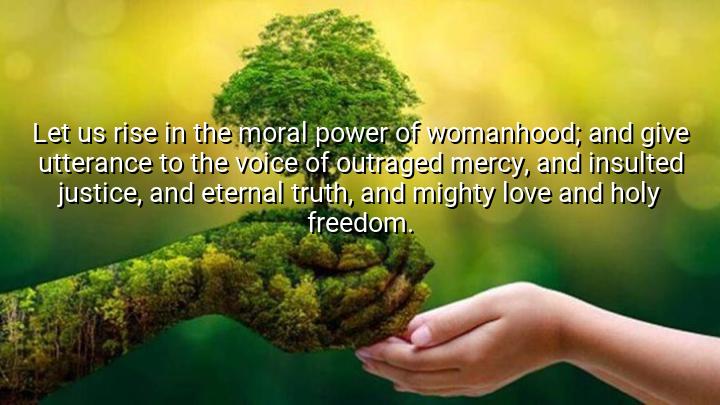




Maria Weston Chapman’s quote, "Let us rise in the moral power of womanhood; and give utterance to the voice of outraged mercy, and insulted justice, and eternal truth, and mighty love and holy freedom," speaks to the empowerment of women in advocating for justice and equality. Chapman, a prominent abolitionist and women's rights activist in the 19th century, is calling upon women to stand strong in their moral convictions and to use their voices to challenge social injustices, particularly those related to slavery and the oppression of women. She emphasizes that women have a unique moral power that, when harnessed, can bring about significant social change.
The mention of mercy, justice, truth, love, and freedom highlights the ethical and humanitarian principles that Chapman believed women should champion. These values represent the foundation of moral power and call for women to rise not just in support of their own rights, but also in defense of broader human rights. Chapman’s vision suggests that women are uniquely positioned to lead the fight for equality and compassion, bringing these ideals into the public sphere in a transformative way.
Chapman’s activism was rooted in her involvement in the abolitionist movement, where she worked alongside other reformers to combat the institution of slavery. By invoking these powerful terms, she is framing the struggle for freedom and justice as a moral cause that requires collective action, particularly by those who are often marginalized, such as women. Her call to rise and speak out suggests that women, as active agents in the pursuit of righteousness, are vital to the success of these movements.
Ultimately, Chapman’s quote is a call for action and empowerment. It urges women to use their inherent moral power to advocate for justice and freedom, not only for themselves but for society as a whole. The quote underscores the belief that womanhood is a force for good in the world, capable of driving positive change and upholding the values of mercy, love, and truth.

AAdministratorAdministrator
Welcome, honored guests. Please leave a comment, we will respond soon