

Let us never know what old age is. Let us know the happiness time brings, not count the years.
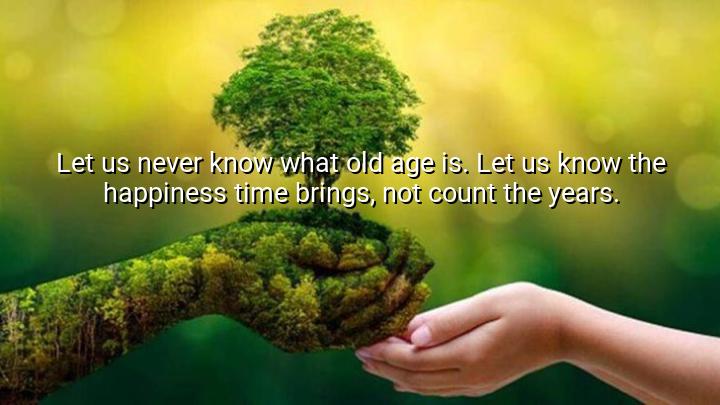




The quote "Let us never know what old age is. Let us know the happiness time brings, not count the years" by Ausonius, a Roman poet and rhetorician, speaks to the idea that the true value of life lies not in the passage of time but in the joy and fulfillment we experience throughout our lives. Ausonius encourages a perspective on life that focuses on the present moment and the happiness that comes from living fully, rather than obsessing over the inevitability of old age and the limitations it might bring.
In the first part of the quote, "Let us never know what old age is," Ausonius suggests that we should not dwell on the concept of aging or allow it to define our lives. Rather than viewing old age as a period of decline or decay, the quote encourages individuals to remain youthful in spirit and to cherish the vitality and joy that life offers at every stage. This sentiment implies that one’s mindset and attitude toward aging can play a significant role in how they experience the later years of life.
The second part, "Let us know the happiness time brings, not count the years," reinforces the idea that time should be measured by the quality of experiences and memories rather than the number of years lived. Instead of focusing on the years that pass, we should prioritize living in a way that brings contentment, gratitude, and purpose. By shifting focus away from age and onto happiness, we can embrace the fullness of life and appreciate the moments that truly matter.
Ultimately, Ausonius’ quote encourages us to shift our focus from the inevitability of aging to the beauty of each passing moment. It advocates for living a life filled with joy, gratitude, and meaning, regardless of how many years have passed. The message is that the value of life is not in how old we are, but in how we experience and embrace the time we are given.

NHNguyen Ha
There’s something deeply freeing in this idea of not 'knowing' old age. It suggests that our experience of time is more about perception than reality. But does this outlook require a certain level of privilege—like good health or financial security—to truly embrace? For those struggling with age-related issues, can the focus on happiness alone be enough? I’d love to hear perspectives from older individuals on this.
TNTrung Nguyen
I appreciate the quote’s focus on joy over numbers. It makes me wonder if people would live differently if birthdays weren’t tracked at all. Would we worry less about what we 'should have accomplished' by certain ages? Or would we feel more lost without time as a guide? I’m really curious how this mindset might influence goal-setting, relationships, or even self-worth.
VVPHAM VAN VINH
This quote made me smile. There’s a kind of ageless optimism in it that I find refreshing. But it also makes me think: do we lose something valuable when we try to 'never know what old age is'? Isn’t aging part of the richness of life, offering wisdom and perspective? Maybe the goal isn’t to avoid aging, but to redefine what it means so it doesn’t feel like a burden.
LTLinh Tran
I love the sentiment here—it feels like a celebration of living in the moment. But I wonder, does this approach risk ignoring the very real challenges that come with aging, like health issues or social isolation? Can we acknowledge the hardships of growing older while still embracing joy and refusing to be defined by our age? It’s a beautiful idea, but I think it deserves a deeper conversation.
PNphuong Nguyen
This quote really made me reflect. Is it actually possible to separate the concept of aging from the passage of time? Society puts so much pressure on age milestones—retirement, beauty standards, etc.—that it feels like we’re trained to measure life in years rather than experiences. How can we train ourselves to focus more on happiness and less on the ticking clock? Is that even realistic in today’s world?