

Let no one be slow to seek wisdom when he is young nor weary in the search of it when he has grown old. For no age is too early or too late for the health of the soul.
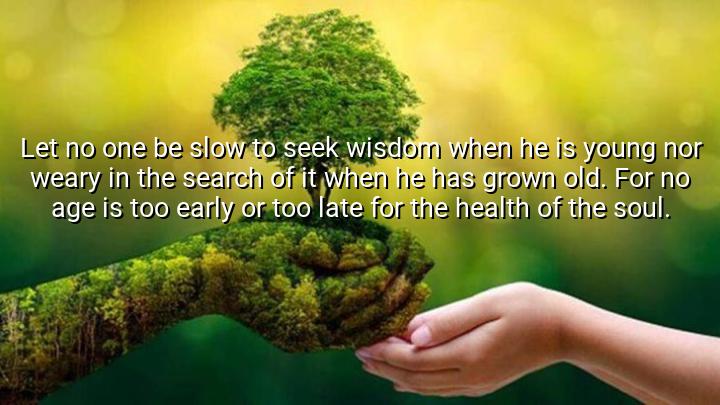




The quote "Let no one be slow to seek wisdom when he is young nor weary in the search of it when he has grown old. For no age is too early or too late for the health of the soul" by Epicurus, an ancient Greek philosopher, emphasizes the timeless nature of the pursuit of wisdom. Epicurus believed that wisdom was essential for achieving a fulfilling life, and this quote suggests that the search for wisdom should not be confined to a particular stage of life. Whether you are young or old, the quest for understanding and self-improvement is always valuable and necessary for the health of the soul.
Epicurus highlights that youth is a time when one should actively pursue knowledge and wisdom, ensuring that one builds a solid foundation for life. On the other hand, he stresses that even in old age, the pursuit of wisdom should not stop, as it continues to nurture and enrich the soul. This perspective encourages lifelong learning and reflection, showing that wisdom is not a destination but a continuous journey that benefits a person at any age.
The phrase "no age is too early or too late for the health of the soul" suggests that wisdom is not bound by time or age. Epicurus encourages individuals to never stop seeking self-knowledge and insight, regardless of their age, as it contributes to their inner peace and spiritual well-being. Whether you are just beginning life or entering the later stages, the pursuit of wisdom is essential for a healthy mind and soul.
Ultimately, this quote encourages a mindset that values wisdom as a lifelong pursuit. Epicurus advocates for a continuous search for knowledge, reinforcing the idea that one should never stop improving oneself or seeking deeper understanding, regardless of age. It is a reminder that the health of the soul is enhanced by an ongoing commitment to growth, learning, and wisdom throughout one's life.

APLe Anh Phuong
I love the philosophical optimism here, but I have a concern: do people really believe this in practice? Many older adults feel ignored, and younger people often don’t get taken seriously when they express deep thoughts. How can we shift culture so all ages are encouraged to speak, think, and grow without shame or limitation? Is it possible to build intergenerational communities rooted in shared pursuit of wisdom?
HANguyen Hoai An
Epicurus’s view almost feels revolutionary in today’s fast-paced, age-categorized world. But I wonder—how can we measure whether someone is actually growing in wisdom? It's not like earning a degree or reaching a goal. Maybe the very act of searching, regardless of the outcome, is what he sees as healing to the soul. If that’s true, then the journey really is more important than the destination.
HGHa Giang
Reading this, I’m struck by how age-neutral the message is. It challenges ageism from both ends—assuming young people can't understand wisdom, and assuming old people are too tired or stuck to grow. Do our institutions—like schools, workplaces, and even families—support this kind of lifelong curiosity? Or do they silently discourage it by labeling people as 'too young' or 'too old'?
HHNguyen Hoang Hiep
I’m curious—how do we define the 'health of the soul' today? Is it peace of mind, ethical living, emotional intelligence? This quote suggests that the soul needs tending just like the body, regardless of age. I wonder if modern education and work culture leave enough space for people to truly seek wisdom, or if we only come to it after burnout or crisis.
NHNgoc Huyen
I find this quote deeply reassuring. In a society obsessed with milestones and achievements by certain ages, Epicurus offers a timeless truth: seeking wisdom is always relevant. But how can we encourage younger generations to value wisdom in a world dominated by instant gratification? And how can older people reignite that pursuit if they feel it’s already too late?