

Judaism doesn't recognize gay marriage, just as we don't recognize milk and meat together as kosher, and nothing will change it... I'm not a hypocrite; I state my positions.
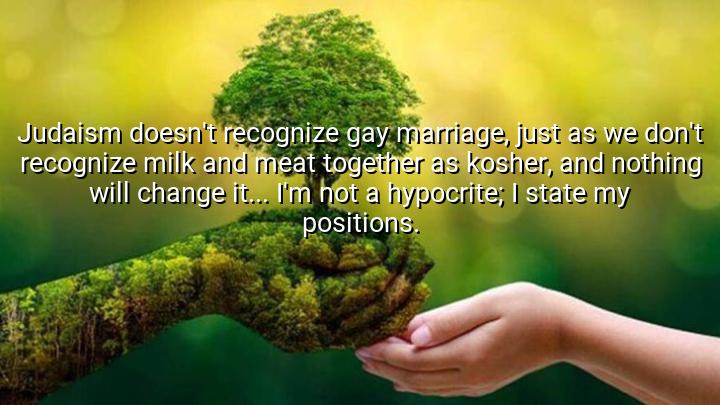




In this quote, Naftali Bennett draws a parallel between Judaism’s stance on gay marriage and the traditional Jewish dietary laws that prohibit mixing milk and meat. He argues that, just as the separation of these foods is a fundamental part of kosher practices, the rejection of gay marriage is an equally non-negotiable aspect of his religious views. Bennett suggests that his position is deeply rooted in his interpretation of Jewish law, and no external pressure will change it.
Bennett’s statement reflects a conservative approach to religious doctrine, where certain beliefs are considered immutable and not subject to societal changes. By saying "nothing will change it," he underscores his commitment to these principles, asserting that his religious convictions are not influenced by public opinion or modern social movements. This highlights the tension that can exist between traditional religious values and more progressive social issues like same-sex marriage.
When Bennett says, "I’m not a hypocrite; I state my positions," he is emphasizing his consistency and honesty in expressing his beliefs. He positions himself as someone who is open and transparent about his views, rather than trying to conform to what might be politically or socially popular. This statement is meant to defend his position against accusations of inconsistency or being out of touch with contemporary values.
Ultimately, Bennett's quote illustrates the clash between religious tradition and evolving social attitudes, particularly on the topic of gay marriage. It reflects his unwavering stance on religious law, showing his belief that his interpretation of Judaism should remain unchanged regardless of shifting cultural norms.

AAdministratorAdministrator
Welcome, honored guests. Please leave a comment, we will respond soon