

It's well proven that if you have equality in society, society flourishes, and if you have inequality, it doesn't. So it's good for everybody.
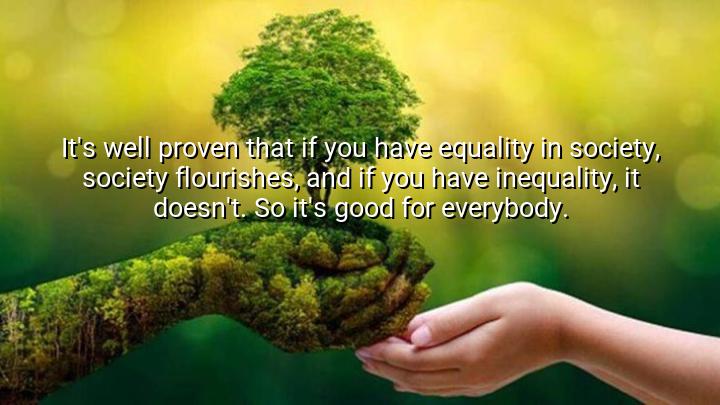




Sarah Gavron’s quote highlights the direct connection between equality and the well-being of society. She asserts that when there is equality within a society—whether in terms of gender, race, or economic opportunity—the society as a whole thrives and prospers. Conversely, when inequality exists, it creates social, economic, and political divisions that hinder growth and development. Gavron’s words reflect the idea that equality is not just a moral imperative but also a practical one, benefiting everyone, regardless of their background.
The origin of this quote comes from Gavron’s work as a director and advocate for social change, particularly in her role in creating films that explore the lives of women and marginalized groups. As a filmmaker, she is deeply invested in stories that address social inequality and how such disparities affect individuals and communities. Her films often explore themes of empowerment and social justice, underscoring the importance of creating a society where everyone has equal opportunities and rights.
Gavron’s statement suggests that equality is foundational not just for fairness but for the broader flourishing of society. When people are treated equally, they can contribute fully to their communities, leading to stronger, more cohesive social structures. Inequality, on the other hand, leads to division, conflict, and missed opportunities for collective progress. Her quote reinforces the idea that equality is a win for everyone, whether in terms of economic growth, innovation, or social stability.
Ultimately, Gavron’s quote serves as a call to action for society to strive for greater equality and address systemic inequality. It highlights that ensuring fairness and equal opportunity isn’t just the right thing to do—it’s also the most effective path to a prosperous, thriving community. Through this lens, equality benefits not only those who are directly impacted by social justice movements but society as a whole.

AAdministratorAdministrator
Welcome, honored guests. Please leave a comment, we will respond soon