

It is utterly false and cruelly arbitrary to put all the play and learning into childhood, all the work into middle age, and all the regrets into old age.
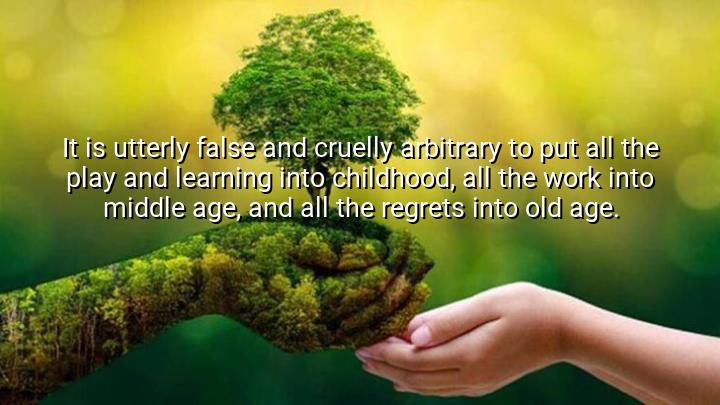




In this quote, Margaret Mead, an influential anthropologist, critiques the conventional societal division of life into distinct stages—childhood, middle age, and old age. She argues that it is false and arbitrary to assign all the play and learning to childhood, all the work to middle age, and all the regrets to old age. Mead is challenging the notion that certain experiences and responsibilities should be confined to specific phases of life, emphasizing that such rigid expectations limit human potential and well-being.
Mead’s statement highlights the flexibility and continuity of human experience. She implies that play, learning, and work are not confined to particular stages but are integral to human development at any age. For example, adults can continue to learn and engage in playful activities, and older individuals can still contribute meaningfully to society and maintain a sense of purpose and joy. By breaking away from traditional life stage expectations, Mead encourages a more holistic view of life that allows for a richer, more balanced existence throughout all phases.
The reference to regrets in old age also underscores Mead’s belief that regret should not be seen as an inevitable consequence of aging. Instead of associating old age with missed opportunities or failures, Mead suggests that older individuals can still find meaning, fulfillment, and growth. This challenges the stereotypical view of old age as a period of decline and invites people to see aging as an opportunity for continued growth and self-fulfillment.
Ultimately, Margaret Mead’s quote advocates for a more integrated and inclusive approach to life’s stages, where each phase allows for a variety of experiences, responsibilities, and personal growth. It calls for the abandonment of restrictive societal norms and encourages individuals to embrace the idea that play, learning, work, and fulfillment can exist at any age, making life a continuous journey of development and enrichment.

TBLe Thi Binh
This resonates deeply in today’s context where longer lifespans challenge old models of aging. If we live well into our 80s or 90s, shouldn’t the distribution of play, work, and reflection also evolve? What practical changes—like flexible careers or lifelong learning programs—would allow people to live more integrated, fulfilling lives across all ages?
LDlinh duong
I love how this quote questions the arbitrariness of how we live. It also raises a deeper philosophical question: why do we let society define our life’s rhythms so rigidly? Could breaking free from these norms lead to a more authentic and fulfilling life? What examples do we see in real life of people who defy this ‘script’ and thrive?
NLNhu Le
This quote makes me wonder about the mental health implications of these life-stage stereotypes. If we accept that regrets belong only in old age, do we risk carrying unnecessary guilt or dissatisfaction for decades? How can we shift our mindset to view every age as an opportunity for growth, joy, and meaningful work, rather than a preset sequence of emotions?
TPTu Phan
Margaret Mead’s words provoke thought about the unfairness of our cultural expectations. If childhood is all about play and learning, why can’t adults continue to play and learn? Does this rigid division contribute to burnout or dissatisfaction during middle age? How can individuals reclaim joy and curiosity at any stage, and what role do communities play in this?
YNY Nhu
I find this quote liberating. It makes me question why we often associate old age with regret and missed opportunities. Could older adults instead be encouraged to explore new passions, learn new skills, and enjoy life just as much as younger people? What societal changes would be needed to support a more fluid, joyful approach to aging?