

It is possible that mankind is on the threshold of a golden age; but, if so, it will be necessary first to slay the dragon that guards the door, and this dragon is religion.
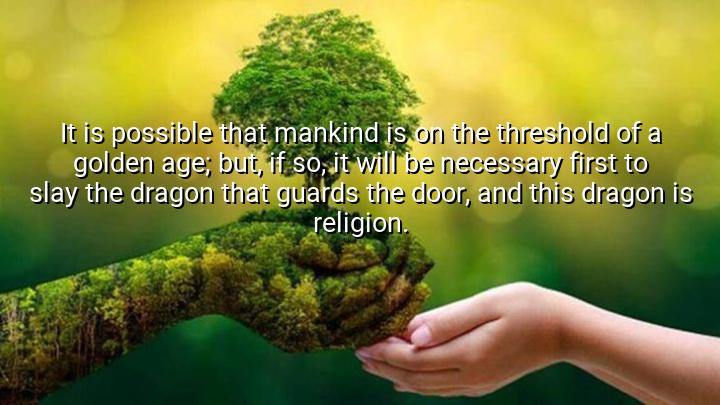




In this quote, Bertrand Russell, a prominent philosopher and social critic, presents a provocative view on the role of religion in human progress. He suggests that mankind may be on the threshold of a golden age, a time of prosperity, enlightenment, and harmony. However, he argues that in order to reach this utopian future, humanity must first overcome the obstacle that stands in its way: religion, which he metaphorically refers to as a dragon guarding the door to progress.
Russell’s comparison of religion to a dragon highlights his belief that religious institutions and beliefs have historically acted as a barrier to intellectual and social advancement. In his view, religion often suppresses critical thinking, scientific inquiry, and the pursuit of reason, which are essential for achieving a better and more enlightened world. The “dragon” symbolizes the power and influence that religion holds over individuals and societies, preventing them from embracing a more rational and humanistic worldview.
The quote reflects Russell’s strong secularism and his critique of the role that religion plays in shaping human behavior and societal structures. He believes that humanity’s potential for a golden age—marked by peace, progress, and reason—can only be realized if religious dogma is set aside in favor of a more rational, empirical approach to solving global challenges. In this sense, the "slaying" of the dragon represents a call for freedom from religious influence to allow for human flourishing based on reason, science, and moral progress.
Ultimately, Bertrand Russell’s quote is a challenge to religious authority and an invitation to think critically about the forces that shape human beliefs and societies. By positioning religion as an obstacle to human progress, he encourages a vision of the future in which reason and rationality guide us toward a more enlightened and just world.

QAnguyen quynh anh
This quote really made me think about the tension between tradition and progress. Religion has been a powerful force in shaping civilizations, but at what cost? Is it holding us back more than it's guiding us forward? I'd be interested in hearing from people who find harmony between their religious beliefs and progressive values. Can both coexist, or must one inevitably give way to the other?
CTNguyen Cong Tan
I find Russell’s analogy dramatic but compelling. If we interpret the 'dragon' as dogmatism, then yes, it makes sense that such a force might block the path to progress. But what about the positive influence of religion on culture, art, and social justice movements? Is it possible to keep the enriching aspects while discarding the restrictive ones? Or are the two too intertwined to separate?
PLNguyen P. Linh
As someone who grew up with faith but has grown increasingly secular, this quote really resonates. It captures my frustration with how religious institutions can sometimes stand in the way of science, education, and equal rights. Still, I hesitate to label religion entirely as a 'dragon.' Isn’t it more accurate to say that rigid dogma—not belief itself—is the real threat to progress?
NMBui Nhat Minh
Bertrand Russell’s view is provocative and definitely invites debate. I can’t help but ask: is it religion itself that's the barrier, or is it the way certain people use religion to justify harmful actions? It seems unfair to paint all spiritual or faith-based traditions as regressive. Could reform, rather than eradication, be the key to integrating religion into a more progressive global future?
GKLe to gia Khai
This quote is striking, but I wonder if it oversimplifies a deeply complex issue. While religion has certainly played a role in conflict and oppression, it has also been a source of compassion, community, and moral guidance for many. Can we really pin humanity’s progress—or lack thereof—on religion alone? What about political ideologies, economic systems, or social structures? I’m curious how others interpret this metaphor of the 'dragon.'