

It is not possible to live in this age if you don't have a sense of many contradictory forces.
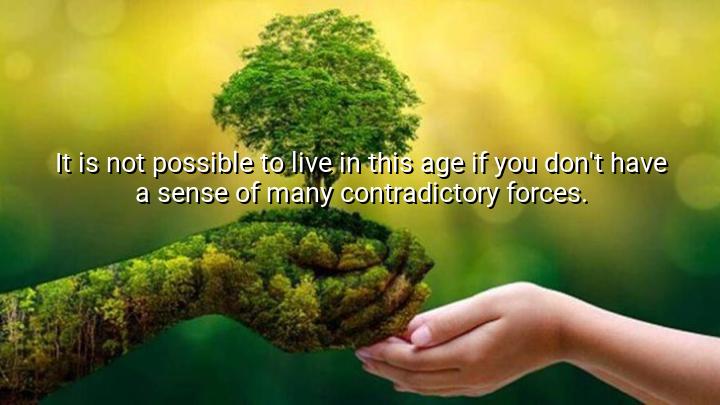




Rem Koolhaas’ quote reflects on the complexity of living in the modern age, suggesting that to truly navigate contemporary life, one must be aware of and able to embrace contradictory forces. He acknowledges that the world today is shaped by a multitude of competing and often opposing ideas, values, and influences that constantly interact and clash. In this context, having a sense of these contradictions is essential for understanding the dynamics of the present.
Koolhaas is highlighting the diversity and tension present in modern society. From political conflicts to cultural divides, these opposing forces influence how we live, work, and relate to one another. By pointing out the necessity of understanding these contradictions, Koolhaas suggests that individuals must be adaptable and open-minded, able to navigate complex and sometimes contradictory aspects of the world around them.
The quote also alludes to the idea that modernity requires us to hold multiple, often conflicting ideas or perspectives simultaneously. In a world where globalization, technology, and rapid social change continually reshape society, people must be capable of understanding and engaging with contradictory views rather than seeking simple, unified answers. This reflects the complexity of living in a rapidly evolving world, where issues are rarely black and white.
Ultimately, Koolhaas is urging us to accept that contradiction is inherent in the modern experience. To thrive in today’s world, one must be comfortable with ambiguity, acknowledging the complexity and diversity of forces at play in shaping the world. Understanding these contradictions is key to engaging with the complexities of the contemporary age.

HNHung Nguyen
This idea resonates a lot in today’s political and environmental landscape. It’s hard to feel like you’re doing the right thing when every solution seems to come with unintended consequences. Should I drive less for the planet, even though my city lacks public transit? Should I support a cause knowing its leadership is flawed? It’s exhausting, but perhaps awareness of these contradictions is the first step toward meaningful action.
NANguyen Ngan Anh
I feel this quote speaks to our cultural and personal identities too. We’re constantly told to 'be authentic,' but we play multiple roles—online, offline, at work, at home. Do you think authenticity now includes being fluid and embracing inner contradiction? Maybe we need a new definition of integrity that allows space for complexity rather than expecting consistency all the time.
TTTuan Tran
This quote makes me think about how architecture, design, and urban life—Koolhaas’ realms—are especially reflective of these contradictions. Skyscrapers rise as homelessness expands. Cities are smart but often alienating. Is it possible to design spaces that acknowledge and adapt to these contradictions, rather than pretending they don’t exist? Can built environments help us live more consciously within paradox?
KLduong tran khanh linh
What I find fascinating here is the acknowledgment that contradiction isn’t just noise—it’s the defining feature of our age. But are we embracing this complexity or trying to numb ourselves to it? I see people gravitating toward extremes as a way to simplify their worldview. Does accepting contradictions mean embracing discomfort as part of growth? That’s a tough but necessary mindset shift.
TLDoan Thi Thao Lam
I completely relate to this. Every day feels like navigating a minefield of competing truths—progress and regression, inclusion and division, freedom and surveillance. Do you think the human brain is built to manage this kind of complexity? Or are we simply overwhelmed, forced to filter and simplify just to stay sane? Maybe our survival now depends on becoming more emotionally and intellectually adaptive than ever before.