

It is by the goodness of God that in our country we have those three unspeakably precious things: freedom of speech, freedom of conscience, and the prudence never to practice either of them.
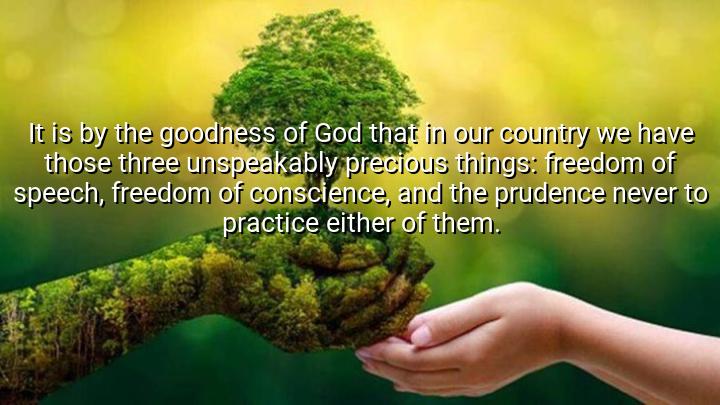




Mark Twain’s quote humorously and critically reflects on the concept of freedom in the United States, particularly the freedom of speech and freedom of conscience. Twain starts by acknowledging that these two rights are precious gifts, given by the goodness of God, and are foundational elements of a democratic society. These freedoms allow individuals to express their ideas and beliefs without fear of retribution, which is considered a cornerstone of personal liberty and social progress.
However, Twain’s quote takes a cynical turn with the second half: “the prudence never to practice either of them.” This statement suggests that, while the freedoms are valued, people often fail to exercise them wisely or responsibly. Prudence, in this case, is about exercising caution or restraint, implying that in practice, individuals may avoid speaking freely or following their conscience out of fear of consequences, social discomfort, or conflict. Twain is pointing out the paradox of having these rights, yet not using them fully because of the social pressures or the risks involved.
The irony in Twain’s quote lies in the contrast between having the rights to speak and think freely and the reluctance to do so. It speaks to the human tendency to enjoy the privileges of freedom but shy away from the responsibilities or potential controversy that come with exercising them. Twain, known for his satirical and often biting commentary, uses this quote to highlight the contradictions within society and human nature, where people are often too cautious to truly embrace their freedoms.
Ultimately, this quote underscores Twain’s trademark wit and social commentary, suggesting that while freedom is essential and highly valued, the fear of what may happen when those freedoms are fully exercised can sometimes prevent people from using them. Twain’s humor here is a reflection on the complexity of freedom and the ways in which society may unintentionally stifle its own liberties by not embracing them with full vigor.

AAdministratorAdministrator
Welcome, honored guests. Please leave a comment, we will respond soon